


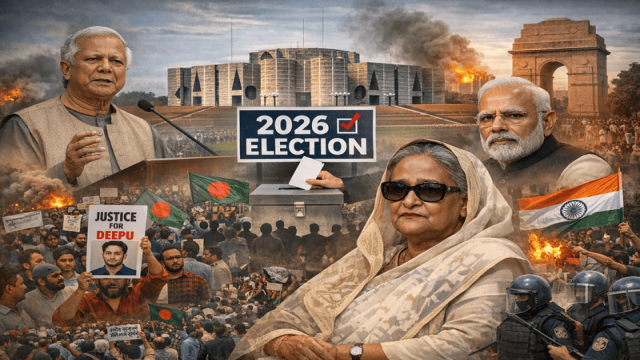
New Delhi, Dec 26 (V7N) – As Bangladesh gradually returns to relative calm following weeks of unrest, the country is preparing for its next general election scheduled for 12 February 2026, amid deep political uncertainty and growing diplomatic strain with neighbouring India.
Bangladesh has recently witnessed political turmoil following the death of young political leader Sharif Osman Bin Hadi, an incident that further intensified anti-India sentiment in parts of the country. Although the situation has begun to stabilise, tensions remain high as the South Asian nation moves towards a crucial national election.
The upcoming polls will take place without the participation of the Awami League, which ruled the Muslim-majority nation of nearly 170 million people for several years. Former Prime Minister Sheikh Hasina was overthrown during a student-led mass uprising in July–August 2024 and has since remained in India along with thousands of her party members.
Hasina was later sentenced to death by a Bangladeshi court on charges of crimes against humanity related to last year’s unrest, which reportedly claimed more than 1,400 lives, including minors. Despite repeated official requests from the interim government led by Nobel laureate Dr Muhammad Yunus, India has remained non-committal on her extradition, contributing to a deterioration in bilateral relations between Dhaka and New Delhi.
Speculation intensified after Sharif Osman Bin Hadi was shot in Dhaka on 12 December. He was later flown to Singapore for advanced medical treatment but succumbed to his injuries on 18 December. Rumours circulated among anti-Hasina activists that the attackers fled to India immediately after the shooting. The prime suspect, Faisal Karim Masud, reportedly linked to the Awami League’s student wing Chhatra League, remains at large. Sections of the public, without confirmed evidence, alleged that he was receiving shelter in India, further fuelling public anger.
Amid the heightened tensions, violent incidents targeting minorities triggered widespread concern. On 18 December, Deepu Chandra Das, a 27-year-old garment worker, was beaten to death by a mob in Bhaluka, Mymensingh, over alleged derogatory remarks about Islam. Days earlier, on 13 December, Uttam Kumar Barman, a 45-year-old grocery shop owner in Rangpur, was similarly killed following accusations of blasphemy. Both incidents sparked protests in India, where demonstrators gathered outside Bangladeshi diplomatic missions demanding justice and greater protection for religious minorities.
The interim government in Dhaka condemned the killings, describing them as heinous criminal acts with no justification. Education Adviser Prof CR Abrar recently visited Deepu’s family to express condolences and reaffirm the government’s commitment to the rule of law. Authorities confirmed that more than 10 suspects have been arrested in connection with the Mymensingh killing.
A recent report by the Brussels-based International Crisis Group stated that Hasina’s continued presence in India has significantly contributed to rising tensions between the two countries. According to the report, the interim government sought her extradition under a 2013 bilateral treaty soon after assuming office, but Indian authorities were unlikely to comply, citing broader regional and diplomatic considerations.
The report further noted that Dr Yunus personally urged Indian Prime Minister Narendra Modi to prevent Hasina from making political statements while residing in India, warning that her public interventions were perceived in Dhaka as unfriendly acts. These remarks were reportedly poorly received in New Delhi. Bangladesh has also expressed dissatisfaction over alleged political activities conducted by Awami League leaders from Indian cities, including Kolkata and New Delhi.
In a recent statement, Sheikh Hasina criticised the Yunus-led interim government, describing it as ineffective and accusing it of presiding over lawlessness. She claimed extremist elements had been placed in key positions, alleged the release of convicted militants, and blamed the current authorities for deteriorating relations with India.
Hasina has rejected calls to return to Bangladesh, stating that she fears political assassination and will only consider returning once a legitimate government with an independent judiciary is established. She also thanked India for providing her shelter since her departure from Dhaka in 2024. India has reiterated that its decision to host Hasina is guided by humanitarian considerations and its longstanding tradition of offering refuge to individuals facing grave threats.
New Delhi has, however, voiced concern over the security of religious minorities in Bangladesh and has called for justice in the recent mob killing cases. Meanwhile, critics question Hasina’s moral standing, arguing that during her long tenure she failed to adequately protect Hindu and other minority communities. Reports suggest she initially explored relocation to a third country, but no state has so far offered asylum.
As Bangladesh moves toward a pivotal election, the political vacuum, unresolved justice issues, and strained regional relations continue to shape the nation’s uncertain path forward.
END/NT/SMA/







Comment: