Dhaka, Aug 05 (V7N)- Today marks August 5, a significant date in Bangladesh's recent political history. Exactly two years ago, on this day in 2024, the Awami League government's 16-year rule came to an end amid a nationwide mass uprising that emerged from the Anti-Discrimination Student Movement. Following 36 days of continuous protests and the loss of thousands of lives, the country entered a new chapter in its political landscape.
The movement, which began with demands for quota reform in public sector recruitment, gradually evolved into a nationwide uprising as people from all walks of life joined the students. Professionals, workers, teachers, parents, relatives of those killed during the protests, and countless ordinary citizens took to the streets in support of the movement.
On the morning of August 5, 2024, Dhaka remained tense as demonstrators gathered for the "Long March to Dhaka" program. As the day progressed, the number of protesters grew rapidly, turning into a massive sea of people by the afternoon. The demonstrations reflected growing public demands for political change and the restoration of democratic governance.
Amid the unfolding events, then Prime Minister Sheikh Hasina left Ganabhaban. Reports of her departure quickly spread across various media outlets, although no official confirmation was initially provided. Public attention then shifted to the scheduled address by the Army Chief.
Although the address was expected at 2:00 p.m., it was delivered nearly an hour later. In his televised speech to the nation at around 3:00 p.m., the Army Chief confirmed Sheikh Hasina's departure from the country.
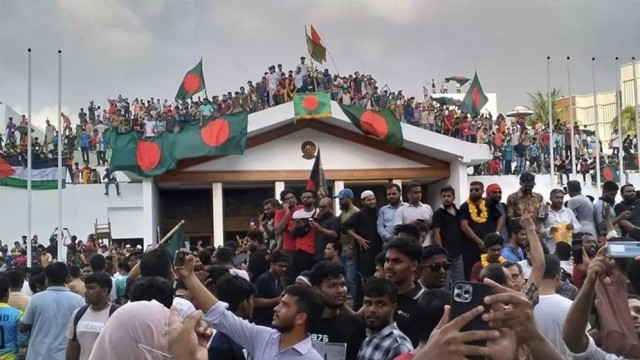
Following the announcement, celebrations erupted across Dhaka and other parts of Bangladesh. Thousands of protesters marched toward Ganabhaban, where large crowds gathered in what they described as a victory procession. The area was filled with people expressing hope for democratic restoration and a new political beginning.
Two years later, August 5 continues to be remembered by many as a defining moment in Bangladesh's contemporary political history. At the same time, the events remain the subject of differing political interpretations and public debate. Analysts say the developments of 2024 continue to shape discussions on governance, democracy, and the country's political future.
END/SMA/AJ