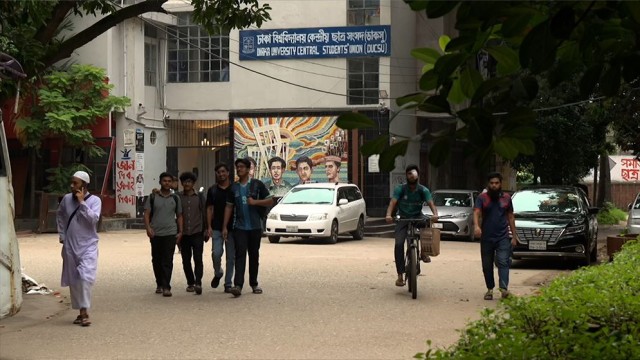
Dhaka, Sep 15 (V7N)- A teacher evaluation website launched by the Dhaka University Central Students' Union (DUCSU) has sparked debate among teachers and students over the process, confidentiality of evaluations and the jurisdiction of student representatives.
DUCSU launched the teacher evaluation website, “DU Evaluation,” on September 10. Since its launch, more than 6,500 students have submitted feedback, resulting in around 11,000 evaluations.
The platform allows students to provide feedback on various aspects of teaching, including teaching methods, teachers’ conduct toward students, examination and assessment practices, and class regularity.
Many students have welcomed the initiative, saying it provides an opportunity to evaluate teachers. However, some students have questioned the way the system was implemented and the publication of individual ratings.
One student said the launch of the website created hope that students would finally have an opportunity to evaluate their teachers. Another described the concept as positive but expressed concern over the controversial manner in which it was implemented.
Some students also warned that the anonymity of the platform could allow users to post arbitrary or disparaging comments. They said some of the comments appeared positive, while many others were negative or made in jest, raising concerns about maintaining appropriate student-teacher relations.
The publication of individual teacher ratings generated further controversy. Several teachers reportedly became targets of trolling and mockery on social media after their ratings were made publicly available. DUCSU subsequently disabled the feature allowing users to view individual ratings.
Teachers generally support the idea of teacher evaluation but argue that such a system should be administered through the university’s formal academic processes.
Dr. Khorshed Alam, an Associate Professor in the Department of Mass Communication and Journalism, said evaluating teachers is not the responsibility of DUCSU or student representatives but of the university administration. He argued that DUCSU exceeded its jurisdiction by undertaking the initiative.
Teachers also pointed out that under international practices, teacher evaluations are generally kept confidential between the teacher concerned and university authorities. While students may provide feedback, they said there are limited precedents for publicly disclosing individual evaluation results.
Dr. Samina Luthfa, a professor in the Department of Sociology, said launching the initiative without going through the university administration infringes upon teachers’ rights.
She said that if the objective was to ensure accountability and improve teaching quality, feedback should have been provided to teachers privately and confidentially. She described DUCSU’s handling of the matter as undesirable and irresponsible.
DUCSU General Secretary S.M. Farhad said the current evaluation system is being conducted as a pilot initiative. Student feedback will be collected during the pilot phase, and changes to the methodology will be introduced if necessary.
Farhad said DUCSU would discontinue its current system if the university administration formally introduces its own teacher evaluation mechanism.
He explained that the initiative is primarily intended to encourage the university administration to establish an official teacher evaluation system.
The DUCSU general secretary also said that although third-party organizations conduct teacher evaluations at universities in different countries, DUCSU does not want an external organization to handle the process at Dhaka University. Instead, it wants the university administration to oversee the entire evaluation system.
While teachers and students broadly agree that evaluation is important for improving teaching quality, differences remain over who should conduct it, how feedback should be handled and whether individual results should be made public.
END/SMA/AJ