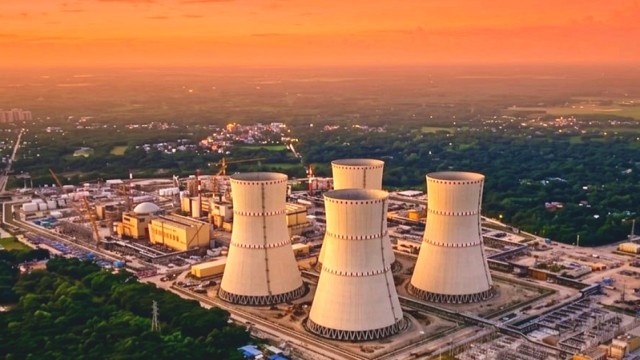
Pabna, Nov 19 (V7N) – Electricity generated by the first unit of the Rooppur Nuclear Power Plant in Pabna was disconnected from the national grid about eight and a half hours after its experimental supply began, marking the completion of the first phase of grid synchronization tests.
The unit's electricity supply was disconnected at 11:50pm on Tuesday. Authorities plan to reconnect it for another four to six hours after a gap of approximately 28 hours as part of the next phase of technical testing.
The first unit was connected to the national grid experimentally at 3:16pm on Tuesday. Officials said the disconnection was part of preparations for the next stage of technical assessments.
Dr. Zahedul Hasan, managing director of the Nuclear Power Plant Company Bangladesh Limited (NPCBL), confirmed that the unit was disconnected from the grid at 11:50pm.
After years of preparation, technical assessments and challenges, Bangladesh achieved a historic milestone on Tuesday when electricity from its first nuclear power plant was supplied to the national grid for the first time.
Twenty-nine minutes after the initial connection, at 3:45pm, the unit's output reached 350MW. Generation was subsequently maintained at 300MW to ensure grid stability. During the first round of testing, the unit's output was gradually increased to a maximum of 375MW.
The historic grid connection began in the presence of Science and Technology Minister Fakir Mahbub Anam. Also present were Prime Minister's Adviser on Science and Technology Rehan Asif Asad, Science and Technology Ministry Secretary Md Anwar Hossain, Bangladesh Atomic Energy Commission Acting Chairman Dr M Moinul Islam, Bangladesh Atomic Energy Regulatory Authority (BAERA) Chairman Mahmudul Hasan, NPCBL Managing Director Dr Zahedul Hasan, Project Director Dr Md Kabir Hossain and other engineers, scientists and officials.
Speaking to journalists, Minister Fakir Mahbub Anam said efforts would be made to gradually increase the first unit's generation capacity to between 1,100MW and 1,200MW by January or February. However, he said the targets were part of the testing process, and the actual increase would depend on test results and regulatory approval.
Dr Zahedul Hasan said the first unit's output had reached 375MW after its experimental connection to the national grid. Before connecting the generator, engineers ensured that its voltage, frequency and other electrical characteristics were compatible with those of the grid.
Following grid synchronization, generation was increased to assess how steadily the power plant's equipment and control systems could operate in coordination with the national grid. Tuesday's connection marked the beginning of this testing process at the first unit.
He said electricity had been supplied to the national grid for approximately eight and a half hours during the first phase. The performance of the turbine, generator and integrated operating systems was assessed during this period.
The unit was then disconnected at around 11:50pm to prepare for further technical tests. A second connection is planned after a gap of approximately 28 hours, with the unit expected to remain connected for four to six hours.
According to the managing director, the schedule was set for the first two rounds of preliminary testing. Generation may be increased or reduced in subsequent phases depending on testing requirements. The unit may also need to be temporarily shut down to complete certain assessments.
He added that electricity supplied to the national grid during testing would be used to meet consumer demand. Power Grid Bangladesh PLC (PGB) would take necessary measures to maintain grid balance during fluctuations in generation and supply.
Project officials said each testing phase would assess the performance of different plant systems, the turbine and generator, and the compatibility of electricity supply with the national grid.
If the initial test results are satisfactory, the project will require approval from the Bangladesh Atomic Energy Regulatory Authority before proceeding to the next phase. Following approval, the first unit will be reconnected to the grid for trial operation.
During this stage, generation will be gradually increased to assess the performance of the nuclear reactor, turbine, generator and automatic control systems.
Under the agreement with Russian contractor Rosatom, the first unit is expected to begin full-capacity commercial electricity supply after a 10-month trial operation period. The 10-month period will begin once trial operation starts following regulatory approval.
After the completion of this phase, the Bangladesh Atomic Energy Commission will initially take over responsibility for the first unit from Rosatom.
Rooppur is the largest single development project in Bangladesh's history. The Bangladesh Atomic Energy Commission, under the Ministry of Science and Technology, is implementing the project, while the government-owned NPCBL is responsible for operating the plant.
Russian contractor Atomstroyexport is constructing two units, each with a capacity of 1,200MW. Once both units become operational, the plant will have a total generation capacity of 2,400MW.
How Rooppur Will Generate and Supply Electricity
The main construction work of the Rooppur Nuclear Power Plant began on November 30, 2017. After years of development, Bangladesh has now reached a major milestone with the experimental supply of electricity to the national grid, beginning an important phase of preparations for commercial operation.
Heat Generation in the Reactor
According to project sources, the reactor is the heart of a nuclear power plant. A controlled nuclear fission reaction inside the reactor produces enormous amounts of heat.
During this process, uranium-235 nuclei split after being struck by neutrons, releasing heat energy and additional neutrons. These neutrons trigger further fission reactions in other uranium atoms, sustaining the process.
The heat generated by fission is used to heat water under high pressure in the primary circuit. Powerful pumps carry this heated water from the reactor to the steam generator.
There, heat from the primary circuit converts water in the separate secondary circuit into steam. The two circuits remain separate, preventing radioactive materials in the primary circuit from mixing with the secondary-circuit water under normal operating conditions.
Steam Powers the Turbine
High-pressure steam produced in the steam generator is directed towards the turbine at a specified pressure and temperature. The force of the steam turns the turbine blades and rotates its shaft at high speed.
In Rooppur's 50-hertz electricity generation system, the turbine-generator rotor rotates at 3,000 revolutions per minute.
The turbine is directly connected to the generator rotor. As the turbine rotates, the rotor spins at the same speed inside the generator's stationary component, known as the stator.
The rotating magnetic field induces an electric current in the stator coils through electromagnetic induction, following the principle established by scientist Michael Faraday.
In this way, heat energy from the reactor is converted into steam, the steam drives the turbine, and the generator converts mechanical energy into electricity.
Electricity Connected to the National Grid
Electricity generated by the generator is initially passed through a step-up transformer to increase its voltage. At Rooppur, the voltage is designed to be raised to approximately 400 kilovolts for transmission to the national grid.
However, electricity cannot be supplied directly to the grid simply because it has been generated. Its voltage, frequency and phase must first be synchronized with the national grid. Other electrical requirements, including phase sequence, must also be met.
This process is known as grid synchronization. Only after all technical conditions are satisfied can electricity from Rooppur be supplied to the national grid.
Initially, the plant is connected at a relatively low generation level. Output is then gradually increased based on test results and technical capabilities.
To increase generation, the rate of nuclear fission inside the reactor is carefully adjusted. This produces more steam in the steam generator, which drives the turbine and enables the generator to produce more electricity.
Electricity to Reach Different Regions Through Seven Transmission Lines
Electricity generated at Rooppur will be connected to the national grid through approximately seven transmission lines, supplying different parts of the country.
These transmission networks will link the plant's output with electricity supply systems serving Dhaka, Bogura, Gopalganj, Pabna, Sirajganj and other areas.
From there, high-voltage electricity will reach various substations through the national transmission network. Transformers at the substations will reduce the voltage to levels suitable for distribution.
Finally, electricity will reach homes, industries, businesses and other consumers through distribution lines.
In this way, electricity generated through nuclear fission will pass through steam generation, turbines, generators, transformers and the national grid before reaching consumers.
The Rooppur Nuclear Power Plant is expected to mark a new chapter in Bangladesh's energy security, electricity generation capacity and technological development.
Speaking to journalists on Tuesday, Science and Technology Minister Fakir Mahbub Anam said the experimental connection to the national grid had been completed successfully and the initial test results were positive.
He said testing would continue for several days, with generation gradually increasing from the current 300MW to 500MW, 700MW and eventually between 1,000MW and 1,200MW.
The unit would be switched on and off at different stages as part of the testing process, he said.
The minister expressed hope that the first unit would reach its designed capacity of 1,200MW by late January or early February, provided the necessary tests were completed successfully.
He described successful grid synchronization as the most significant achievement of the latest milestone and said Prime Minister Tarique Rahman had expressed gratitude to the people of Bangladesh.