Rajshahi, Nov 19 (V7N) – Once regarded as a burden for farmers, jute cultivation is now bringing renewed hope to growers in northern Bangladesh, as both jute fibre and jute sticks are fetching good prices. Farmers are increasingly benefiting from selling jute sticks alongside the fibre, bringing smiles to their faces.
In the past, jute sticks were mainly used to build fences around rural homes and as household fuel. However, with the expansion of technology and industrial uses, they have gradually become a valuable commercial product. Demand has increased from betel-leaf gardens, particle-board manufacturers and charcoal factories.
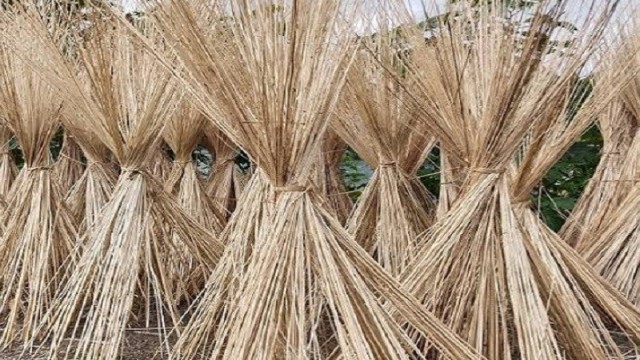
In Godagari upazila of Rajshahi, farmers are now busy drying jute sticks after separating the fibre from the stalks. The sticks are being bundled and laid out to dry along rural roads, sometimes stretching for miles.
Jute sticks have long been used as cooking fuel, fencing materials and for making household items and decorative products. Their use has now expanded to particle-board production and various industries, significantly increasing their market value.
A visit to Kumarpur, Rajbari, Char Ashariadaha, Kanapara, Bhatupara, Bidirpur, Premtali and Basudebpur in Godagari revealed jute sticks spread out for drying along both sides of roads.
In some areas, women from nearby villages help jute farmers separate the fibre in exchange for the jute sticks, which they collect as fuel for cooking.
Jute farmer Abdul Matin said traders from distant areas were coming to buy jute sticks directly from farmers. He said a bundle was selling for Tk 100 to Tk 120.
Meanwhile, traders are purchasing jute sticks from farmers in different villages at relatively low prices and transporting them by vans to nearby towns for resale at higher prices.
Jute-stick trader Jalal Sheikh said the current period was the peak season for sales. “We buy jute sticks from farmers at Tk 20 to Tk 30 per bundle and sell them in town for Tk 50 to Tk 60. We earn around Tk 1,500 to Tk 2,000 per vanload,” he said.
Godagari Upazila Agriculture Officer Morion Ahmed said the area had recorded a bumper jute harvest this year, with no major problems reported in retting. Jute prices were also favourable, with each maund selling for Tk 4,900 to Tk 5,100 in local markets.
She said demand for jute sticks was rising because they were being used in betel-leaf gardens, carbon factories and other industries. The growing demand was creating an additional source of income for farmers in the region.