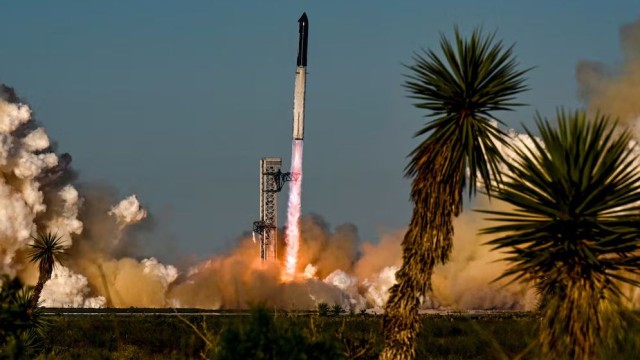
Texas, Nov 15 (V7N)- SpaceX's Starship spacecraft has successfully returned from orbit and been caught by the giant mechanical arms of its launch tower for the first time, marking a major engineering milestone in the company's effort to develop a fully reusable rocket system.
The historic manoeuvre took place on Saturday (November 14) at the Starbase launch facility in Texas, United States, after a mission lasting more than 22 hours in orbit.
Following nearly a day in space, the 171-foot-tall Starship descended through dense clouds before restarting its engines and manoeuvring into an upright position. It then slowly descended towards the giant mechanical arms of the launch tower, known as 'Mechazilla'.
With its engines still roaring, the spacecraft was carefully caught by the mechanical arms before shutting down its engines and coming to a standstill. It was the longest mission in Starship's history.
The mission began on Friday when the rocket's lower stage, the Super Heavy Booster, launched Starship into orbit from Starbase. Under the original plan, the booster was also supposed to return to the launch site about 10 minutes after liftoff. However, it failed to complete the return manoeuvre, preventing SpaceX from recovering both stages during the same mission.
Despite the booster's failure, the successful return of the upper stage after completing 14 orbits of Earth and spending more than 22 hours in space is being viewed as a significant engineering achievement.
During the mission, Starship deployed 26 Starlink satellites into orbit at an altitude of approximately 161 miles, or 260 kilometres. It later fired one of its engines to prepare for atmospheric re-entry.
Travelling at nearly 17,000 miles per hour, the spacecraft encountered extreme heat as it re-entered Earth's atmosphere. It then slowed during its descent towards the Starbase facility on the Gulf Coast of South Texas.
The achievement represents an important step towards SpaceX founder Elon Musk's ambition to develop a rocket system that can travel to space and return to Earth for repeated use.
SpaceX's Falcon 9 rocket has been central to the company's dominance in the global space launch industry. It has completed more than 700 launches since 2010. Although its first stage is reusable, the second stage, which carries payloads into orbit, is discarded after each mission.
Musk aims to overcome that limitation with Starship, developing a fully reusable transportation system capable of flying to space at regular intervals, much like commercial aircraft.
The spacecraft is also expected to play a major role in SpaceX's Starlink satellite business and the company's longer-term plans to establish data centres in orbit, return humans to the Moon and eventually send people to Mars.
However, Saturday's achievement does not mean the entire Starship system is yet fully reusable. SpaceX has still not demonstrated the successful recovery of both rocket stages in a single mission.
The spacecraft's thermal protection system also requires further development. Its heat shield, made of specialised black hexagonal tiles, protects it from extreme temperatures during atmospheric re-entry. SpaceX is working on a new design intended to reduce or eliminate the repairs and maintenance required after each flight.
NASA's Space Shuttle programme, retired in 2011, also used partially reusable spacecraft to transport astronauts to the International Space Station. However, the external components used to propel the shuttle into space were discarded, while the reusable spacecraft required extensive repairs and maintenance before subsequent missions.
END/SMA/AJ