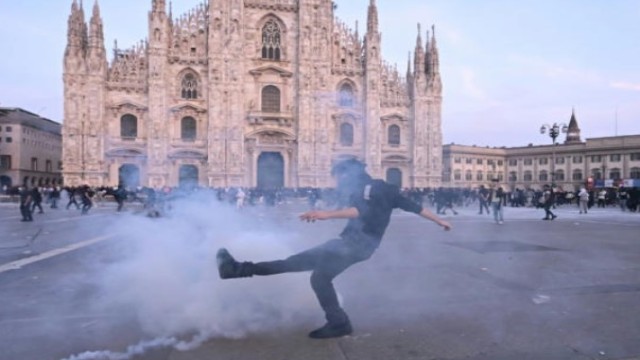
Rome, October 23, 2026 (V7N) – From blockaded schools in Rome to tent camps in Madrid and street protests in France, young people across Europe are turning their anger on a political class they say is not listening.
Their demands vary, but they are united in wanting to make their often marginalised voices heard, sometimes even with radical methods in the face of heavy-handed policing.
"We are fighting and taking our future in our hands," said Damiano Fusa, 18, a student at Rome's Cavour high school, the first to be occupied in a wave of student takeovers that has spread across the Italian capital. "We're not represented by anyone," Fusa told AFP, criticising both Prime Minister Giorgia Meloni's hard-right coalition and previous centre-left governments for cutting education funding and ignoring young people's needs.
Hundreds of thousands of high school and university students have rallied in France, Italy, Spain and other European countries in recent weeks, with some protests descending into violence. Governments have largely focused on restoring order, with France imposing partial curfews and Italy deploying soldiers — responses protesters say obscure their demands and could make things worse.
"Politicians are responding in ways that are completely disconnected from reality, completely absurd," said Luis Marques, a 19-year-old psychology student in Lisbon.
Students are demanding action on soaring rents, more spending on education instead of defence and more job opportunities for young people. Experts say the unrest reflects a broader sense among many young Europeans that they have been shut out of politics.
"These young people do not just feel like they do not have a place in politics, they feel they are not being heard at all," said Geoffrey Pleyers, president of the International Sociological Association. Rosario Forlenza, a professor at Rome's Luiss University, called it a "European generational revolt" rooted in a social and economic crisis "to which politicians cannot give a substantive response."
The anger has been particularly palpable in France and Italy, where fresh demonstrations are planned for Saturday. "People are very angry, they've had enough. Working hard all day and still not being able to fill up their shopping cart," a 20-year-old student who gave his name as Eddy told AFP at a protest in Bordeaux last weekend.
Protest movements across Europe are increasingly drawing inspiration from one another, and even looking to youth-led movements further afield in places like Bangladesh, India and Nepal. In Italy, one student slogan last week urged protesters to "do as in France," while shared symbols, including the Jolly Roger pirate flag, have become common across youth rallies.
Marcos Navarro, 22, a laboratory quality-control technician from Madrid, said protesters across Europe were meeting to share tactics. "They've come to ask us: 'How did you do it? How do you organise yourselves?' We've already exchanged ideas," said Navarro, who has been camping with hundreds of others in Madrid's central Puerta del Sol square since September to protest housing costs and evictions.
Concern about the rise in military spending in Europe following the Russian invasion of Ukraine has also been a rallying point. Nikos Mavroudis, a 17-year-old high school student in Athens' Exarchia neighbourhood, said the money could be better spent on his school, where chunks of plaster are falling. "It's not acceptable for classrooms to be dangerous," said Mavroudis.
At Rome's occupied Morgagni high school, where students have barricaded entrances with desks, protesters pointed to crumbling infrastructure as evidence of neglect. An 18-year-old, who did not want to be named, said the media and politicians in Italy were focusing too heavily on looting and vandalism by some protesters. "It turns hatred against the students who are victims of this system," he said.
Asked about the violence, Sabrina Brizzola, 24, coordinator of the Italian University Students' Union, said organisations like hers should "organise and channel this generational rage." "We have shared concerns, even if our ways of protesting differ," she said.
With new demonstrations called for Saturday in France and Italy, the coming days will test whether governments can bridge the gap with a generation that increasingly doubts the ballot box can deliver change.