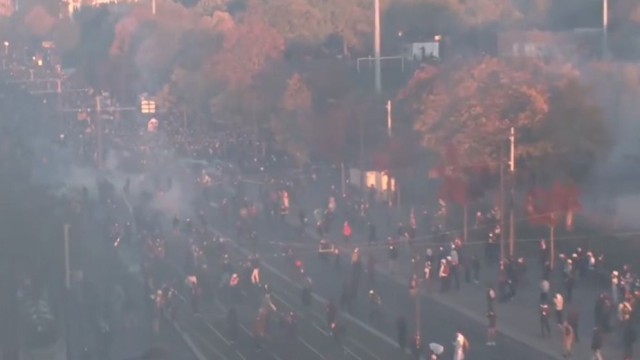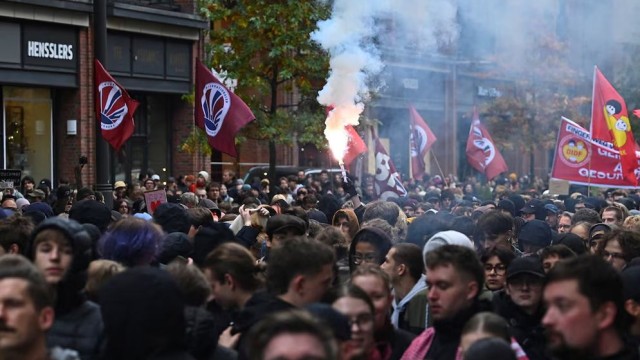
Frankfurt, Nov 01 (V7N)- Youth-led protests demanding better education, lower living costs and an end to compulsory military service turned violent in parts of Germany on Saturday night, with masked rioters looting shops and damaging businesses in the financial hub of Frankfurt.
At least two stores were looted and several others damaged as police struggled to control the situation, Reuters reported.
Frankfurt police said in a post on X that violent disturbances were continuing in the city centre, where shop windows had been smashed and petrol bombs thrown at emergency personnel. Authorities urged members of the public to avoid the area or leave the city centre.
Protests Held in 34 Cities
The demonstrations were organised by the campaign group Gen Z regelt, meaning “Gen Z takes charge,” in 34 German cities, including Berlin, Frankfurt and Munich.
The movement called for increased investment in education and healthcare, measures to address rising living costs, opposition to compulsory military service and a fairer distribution of economic responsibilities.
Turnout fell short of organisers’ initial expectations. Organisers had anticipated around 182,000 participants, but police in Frankfurt, Munich and Berlin reported a combined maximum of approximately 18,000 protesters. The organisers’ website listed attendance at around 36,000.
German authorities said most demonstrations had remained peaceful during the day. However, violence broke out later, while some barricades were set on fire in Hamburg.
Young Protesters Demand Investment in Education
Addressing a rally in Berlin on Saturday, Gen Z regelt spokesperson Lina Friedrich said the movement was taking to the streets to demand peace and freedom rather than war and coercion.
The group has called for greater support for education and healthcare, alongside opposition to compulsory military service.
The protests reflect growing concerns among young Germans about economic pressures, public spending cuts and the condition of educational facilities. Germany is also facing challenges linked to an ageing population, the retirement of baby boomers and mounting pressure on pensions and public services.
Steve, an 18-year-old scheduled to speak at the Munich rally, criticised the government’s response to young people’s concerns, saying it was cutting spending while placing additional burdens on the younger generation.
Sean Baker, a student at the Technical University of Berlin, joined the demonstration to highlight the deteriorating condition of university buildings. He told Reuters that some campus rooms looked abandoned despite students continuing to use them.
Authorities Warn Against Extremist Involvement
German authorities have warned that extremist groups could attempt to exploit the protests. The Interior Ministry said some far-left groups and organisations linked to foreign extremist movements had sought to mobilise support for the demonstrations.
Hesse State Interior Minister Roman Poseck cautioned against allowing the violence seen during recent protests in France to become a model for Germany.
Ahead of the demonstrations, some businesses in German cities took precautionary measures, including boarding up shop windows and closing early. Several stores along Berlin’s Kurfürstendamm shopping boulevard also prepared for possible unrest.
Questions have also emerged over the organisation and leadership of the movement. Germany’s national school students’ organisation, BSK, distanced itself from the initiative and announced plans to hold a separate protest on November 20.
The demonstrations are part of a wider wave of youth-led protests across Europe this year, driven by concerns over living costs, public services, education and political accountability. While student activism has played a significant role in political developments in countries such as Serbia, protests in France have also been marked by clashes, vandalism and looting.
END/SMA/AJ