Dhaka, Jan 06 (V7N)– Chief Advisor Dr. Muhammad Yunus has expressed deep concern over the presence of plastic and the unusual abundance of jellyfish at the bottom of the Bay of Bengal. He stressed the importance of research and problem identification in the deep sea to ensure sustainable use of marine resources.
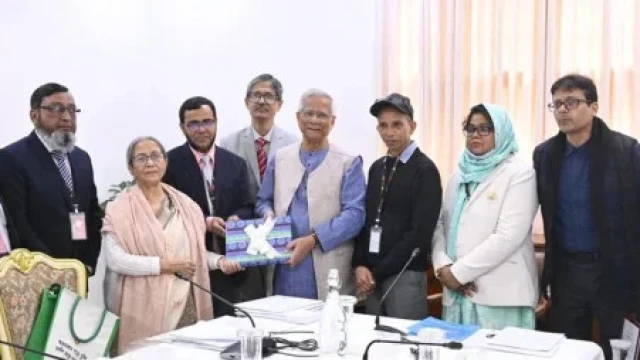
Dr. Yunus made the remarks during a briefing on Tuesday morning, when a committee handed over the survey and research report on marine fisheries and ecosystems, conducted by the research vessel RV Dr. Fridtjof Nansen, to him. The study was carried out from August 21 to September 21 last year by a team of 25 scientists from eight countries, including 13 Bangladeshis.
Professor Sayedur Rahman Chowdhury of the University of Chittagong’s Institute of Marine Sciences presented the findings. He said that jellyfish populations in Bangladesh’s deep sea have increased excessively, indicating an ecological imbalance largely caused by overfishing. Plastic was also found at depths of up to 2,000 meters, which he described as alarming.
The study compared current data with 2018, revealing a decline in large deep-sea fish and a significant decrease in fish at shallower depths. Currently, 270 to 280 large trawlers operate in the deep sea, with 70 of them using sonar-based targeted fishing, which is considered highly aggressive. While this method may catch large fish, it threatens small-scale fishermen and the long-term health of marine resources.
Fisheries and Livestock Advisor Farida Akhtar warned that if sonar fishing continues unchecked, there is a risk that the Bay of Bengal could become depleted of fish, and the government will make decisions regarding its regulation.
On a positive note, the study noted an abundance of tuna, offering bright prospects for the sector. Additionally, a fishing nursery under the Sundarbans has been discovered, and the government has ordered its preservation.
The Chief Advisor emphasized that adequate research and policy support are needed to utilize Bangladesh’s marine resources. He noted that while the country has a water area equal to its land area, it has not yet been able to fully exploit this vast potential.
END/SMA/AJ