
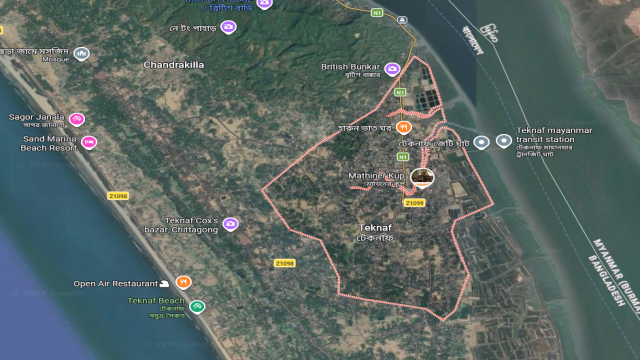
COX’S BAZAR, April 19, (V7N) — A series of operations in Teknaf and Ukhia have exposed the tense security situation in Rohingya camps and border areas, with arrests, drug seizures, a suicide case, and a landmine blast reported.
Law enforcement agencies including APBn, district police, RAB, Ansar, and the Department of Narcotics Control carried out raids in seven Rohingya camps under the direction of APBn Commander Mohammad Kausar Sikder. From Noyapara camp, two convicts were arrested — Md. Rafik (19), sentenced to seven years under Penal Code 399, and Arfa Khatun (60), sentenced to six months under the Narcotics Control Act. From Shalbagan camp, theft case accused Kamal Hossain (30) was detained, while three gamblers were caught in Leda camp and sentenced by a mobile court. In Jadimura camp, narcotics case accused Abdullah (45) was arrested.
The Border Guard Bangladesh (BGB) seized 70,000 yaba tablets worth Tk 2.1 crore in two separate operations. At Hnila border, BGB’s 64 Battalion intercepted traffickers crossing the Naf River, arresting Md. Tofayel (21) and Md. Yunus (33) with 50,000 pills. Later at Whykong, another suspect, Md. Sifat (20), was detained with 20,000 pills. BGB confirmed that anti‑trafficking drives will continue along the Bangladesh‑Myanmar frontier.
Meanwhile, police recovered the body of Mohammad Nasir Uddin (20), a coconut seller, who was found hanging inside his aunt’s house in Inani, Jaliapalong union. Family members discovered him Sunday morning after he had locked himself in overnight. The body was sent to Cox’s Bazar Sadar Hospital for autopsy.
A special operation led by Inspector Kamal Hossain of Teknaf Model Police Station resulted in 18 arrests, including absconding convicts in GR and CR cases, warrant‑listed accused, and several held under regular cases. Police said such drives will continue to ensure public safety.
In Palangkhali union, Ukhia, a Rohingya youth, Amir Hossain (27), was injured in a landmine explosion inside Myanmar territory near the Naf River. Family sources said the blast was likely caused by mines planted by the Arakan Army. He is undergoing treatment at Cox’s Bazar Sadar Hospital.
Authorities stressed that these operations are part of ongoing efforts to restore order in the camps, prevent cross‑border crime, and protect vulnerable communities. The combination of camp insecurity, drug smuggling, and landmine risks highlights the precarious situation in Cox’s Bazar.
Locals expressed concern that despite regular raids, drug trafficking and camp‑based crimes remain persistent. Law enforcement agencies argue that coordinated efforts are gradually yielding results, pointing to the large seizures and arrests as evidence of progress.
The suicide case in Ukhia has added to the sense of unease, with residents worried about rising social pressures in impoverished communities. Police said investigations are underway to determine the circumstances surrounding the death.
The landmine incident has further heightened fears along the border, where clashes between armed groups in Myanmar often spill over into Bangladesh’s frontier areas. Security forces said they are monitoring developments closely to prevent escalation.
Officials acknowledged that Cox’s Bazar faces a complex mix of humanitarian and security challenges. With over a million Rohingya refugees living in camps, the area has become vulnerable to crime, trafficking, and external threats.
Law enforcement agencies reiterated their commitment to maintaining vigilance, promising that special operations will continue to target criminals and smugglers. They emphasized that public safety remains the top priority.
The unfolding situation in Teknaf and Ukhia reflects the broader struggle to balance humanitarian needs with security imperatives in Bangladesh’s border districts.
END/SIU/RH/






Comment: