


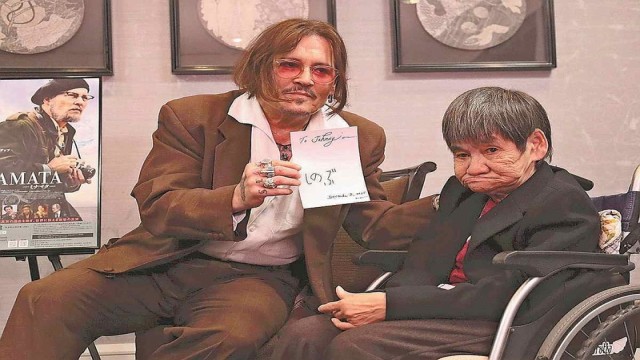
Tokyo, Dec 04 (V7N) – Shinobu Sakamoto, a 69-year-old survivor of fetal Minamata disease, met U.S. actor Johnny Depp on Tuesday at a Tokyo hotel, where the Hollywood star expressed deep admiration for her lifelong struggle and pledged support for raising global awareness of mercury poisoning.
Depp, who is currently visiting Japan, played photojournalist W. Eugene Smith in the 2020 film “Minamata,” which depicted the catastrophic mercury contamination in Kumamoto Prefecture caused by industrial wastewater from the Chisso Corporation in the mid-20th century. The actor said Sakamoto possesses “a truly beautiful heart” and that her courage continues to inspire those advocating for environmental justice.
At the start of their meeting, Depp held Sakamoto’s hand and listened to her describe how patients and their families remain affected nearly 70 years after Japan officially recognized the disease. When asked to visit Minamata, Depp responded positively and said he is willing to travel there to meet other victims and learn more about their continuing challenges.
Minamata disease, one of the world’s most severe examples of industrial pollution, was caused by the release of methylmercury into local waters, contaminating fish and shellfish consumed by residents. Thousands suffered neurological damage, including vision and hearing impairment, loss of motor control, tremors, muscle weakness, and in severe cases paralysis or death. Many infants, like Sakamoto, were affected in the womb, resulting in lifelong developmental and neurological disabilities.
Japanese medical experts, including researchers at Kumamoto University, note that despite decades of government efforts, many survivors still face social stigma, inadequate compensation, and limited access to long-term medical care. Environmental health scholars say the effects of mercury poisoning can persist across generations and highlight that Minamata’s legacy remains a cautionary example of industrial negligence.
The Japanese Ministry of the Environment has acknowledged that numerous victims continue to struggle with chronic symptoms and economic hardship. Specialists warn that mercury pollution remains a global threat, particularly in regions lacking strict industrial waste regulations. They emphasize the need for stronger monitoring of seafood contamination and stricter enforcement of environmental standards to prevent similar tragedies.
Sakamoto told Depp that the world must recognize the suffering endured by Minamata’s victims. “We developed the disease not because we wanted it. I want all people to understand the reality of what happened and why it must never happen again,” she said.
Her meeting with Depp has renewed public focus on Japan’s worst environmental disaster and reinforced calls for international cooperation to reduce mercury emissions and protect vulnerable communities worldwide.
END/WD/SMA/





















Comment: