WASHINGTON, Mar 28 (V7N) – The military landscape of the Middle East shifted further today as the United States moved to create a historic concentration of naval power, while Israel’s top military commander issued a stark warning about the sustainability of the IDF's multi-front operations.
U.S. Naval Buildup: The Three-Carrier Posture
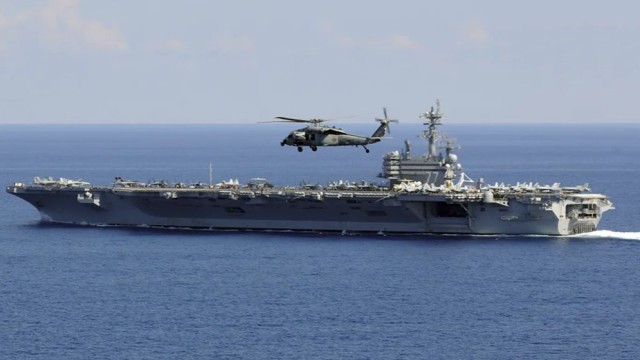
The U.S. Central Command (CENTCOM) confirmed that the USS George H.W. Bush (CVN-77) has been ordered to the Middle East theater
-
Firepower Concentration: The Bush will join the USS Gerald R. Ford (currently in the Red Sea) and the USS Abraham Lincoln (operating in the Arabian Sea). This deployment marks the first time since the 2003 Iraq invasion that three American nuclear-powered aircraft carriers will operate simultaneously in the region.
-
Strategic Role: Military analysts suggest the Bush may be tasked with securing the Eastern Mediterranean and the Red Sea to neutralize threats from Yemen’s Houthi rebels, who officially entered the war this morning with a missile strike on southern Israel.
-
Force Fatigue: The arrival of the Bush is also intended to provide a relief window for the crew of the Ford, which has been on an extended 11-month deployment.
IDF "10 Red Flags": A Warning of Internal Collapse
While the U.S. bolsters its presence, Israel is facing a severe internal personnel crisis. Lieutenant General Eyal Zamir, the IDF Chief of Staff, reportedly delivered a "shattering" briefing to the security cabinet this week, warning that the military is reaching its breaking point.
-
The "10 Red Flags": Zamir presented ten warning signs of systemic failure, citing "exhausted reservists," "mounting operational demands," and a critical shortage of roughly 15,000 soldiers (including 8,000 combat troops).
-
Manpower Crisis: The Chief of Staff warned that without immediate legislative intervention, the IDF "will collapse in on itself." He specifically called for:
-
A Mandatory Service Extension: Reverting the service period for men from 30 back to 36 months.
-
Ultra-Orthodox (Haredi) Conscription: Ending long-standing draft exemptions for yeshiva students to fill a 20,000-soldier gap.
-
Reserve Duty Reform: New laws to prevent the total burnout of the current reserve system
-
Political Deadlock
Prime Minister Benjamin Netanyahu has signaled intent to move forward with these laws after the Passover holiday, but his government faces a fragile coalition. His Haredi partners have threatened to boycott parliamentary votes over conscription, while opposition leaders like Yair Lapid have called the situation a "security disaster" caused by "pushing the army into war without enough soldiers."
The Multi-Front Strain
The IDF is currently managing active combat operations in:
-
Iran: A high-intensity air and missile campaign.
-
Southern Lebanon: Ground operations against Hezbollah.
-
Gaza: Continued stabilization and anti-insurgency missions.
-
The West Bank: Surging violence and a recent diversion of an entire infantry battalion to secure settlements.
As the war enters its second month, the contrast between the arrival of fresh U.S. naval assets and the reported "exhaustion" of the Israeli ground forces highlights the mounting difficulty of sustaining a high-intensity regional conflict.
END/SMA/AJ