Teknaf, July 27 (V7N) — Bangladesh's iconic Cox's Bazar–Teknaf Marine Drive is facing growing threats from powerful waves, tidal surges and heavy monsoon rains, prompting renewed calls from environmentalists, tourism stakeholders and local residents for long-term coastal protection measures.
Experts say the installation of additional geo-tubes and sea walls, alongside comprehensive coastal zone management and large-scale coastal afforestation, is essential to safeguard the country's longest marine road from escalating erosion.
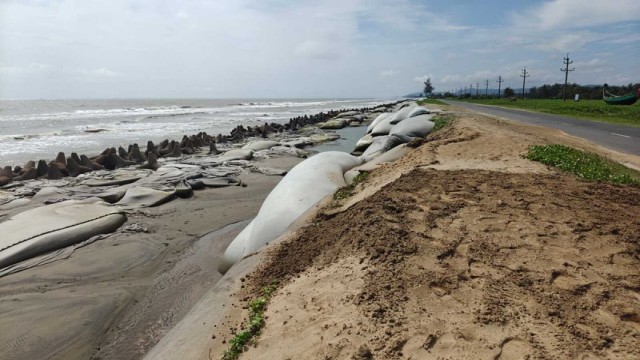
Although the Bangladesh Army, working under the Roads and Highways Department (RHD), has been carrying out continuous repair work on damaged sections of the road, local environmental advocates warn that temporary maintenance alone will not be sufficient as climate change accelerates coastal erosion.
Calls for Permanent Protection
Residents and environmental campaigners believe that without sustainable intervention, the small erosion points already visible along several stretches of Marine Drive could eventually develop into major structural failures.
They have urged authorities to install geo-tubes and sea walls at vulnerable locations while protecting and restoring natural coastal vegetation, including beach creepers and sand dune ecosystems that serve as natural barriers against wave action.
Public awareness campaigns aimed at preventing the destruction of coastal forests have also been identified as a crucial part of long-term protection efforts.
Army Continues Emergency Repairs
According to the Roads and Highways Department, sections of Marine Drive are naturally vulnerable to damage from rough seas and extreme weather.
Since the road was constructed, Bangladesh Army engineering teams have carried out emergency repairs whenever erosion has occurred, ranging from minor washouts to major damaged sections. Even larger damaged areas have been restored through joint efforts by the Army and the Roads and Highways Department.
Environmental experts, however, argue that climate change, increasing human pressure on the coastline and widespread destruction of coastal vegetation have significantly weakened the area's natural defence system, making the road increasingly vulnerable.
Tourism Increases Pressure
Local tourism operators note that Marine Drive remains one of Bangladesh's most popular tourist destinations throughout the year, with visitors travelling from Cox's Bazar to destinations including the Sabrang Tourism Park.
The growing volume of tourist traffic has increased pressure on the coastal highway, reinforcing the need for stronger protective infrastructure.
Tourism stakeholders have urged the government to expand sea wall and geo-tube installations to additional vulnerable locations, particularly around Sabrang, following similar projects already completed at Inani, Patuar Tek and Shah Porir Dwip.
Geo-Tubes Replacing Traditional Protection
Authorities previously relied on concrete blocks and geo-bags to protect the coastline from wave action. These are now gradually being replaced by larger geo-tubes, while permanent sea walls are being constructed at major erosion hotspots.
Sea walls have already been completed in Inani, Patuar Tek and Shah Porir Dwip, and the Roads and Highways Department says similar protection is planned for erosion-prone areas in Sabrang.
Marine Drive's Development
Construction of the Marine Drive project began in September 1993 under the Roads and Highways Department, with implementation by the Bangladesh Army's 16th and 17th Engineering Construction Brigades (ECB).
The project was later approved by the Executive Committee of the National Economic Council (ECNEC) and implemented in three phases.
The first 24-kilometre section from Kolatoli to Inani was completed in 2008 at a cost of Tk 93.77 crore.
The second 24-kilometre stretch from Inani to Shilkhali was completed in June 2016 at a cost of Tk 474.68 crore.
The remaining 32 kilometres from Shilkhali to Teknaf were completed in 2018 with an expenditure of approximately Tk 203.06 crore.
Built at a total cost of about Tk 771.51 crore, the 80-kilometre Marine Drive is one of Bangladesh's most significant coastal infrastructure projects. It was officially inaugurated by the then Prime Minister on May 6, 2017, and has since become a major tourism corridor. Expansion work to widen parts of the road is currently underway.
Environmental Concerns
Bangladesh Film Artists' Association Vice-President and Baharchhara native Elias Cobra praised the Bangladesh Army for its regular maintenance of the highway.
He said seasonal hill runoff and strong ocean waves continue to damage certain sections every monsoon and called for a modern, permanent engineering solution to ensure the road's long-term sustainability.
Prominent environmental and development activist Md. Shahidullah Shahid said rising sea levels caused by climate change are steadily increasing pressure on Bangladesh's coastline.
At the same time, he said, year-round tourism and growing human activity prevent sand from naturally accumulating along beaches, while native coastal plants that help stabilise dunes are increasingly disappearing.
"As a result, the coastline's natural defence system is becoming weaker every year," he said.
He added that in many places waves now crash directly against the Marine Drive embankment where wide sandy beaches once existed.
Although afforestation programmes involving casuarina and other coastal species have been undertaken, illegal felling by a small number of individuals has undermined these efforts.
Without stronger coastal management, protection of sand dunes, conservation of native vegetation, improved security for newly planted forests and greater public awareness, he warned that Marine Drive and other coastal infrastructure across Bangladesh will face even greater risks in the future.
Authorities Assure Continued Action
Roads and Highways Department Executive Engineer Rokon Uddin Khaled said engineers have already surveyed vulnerable sections where wave action threatens the road.
Areas including Himchhari, Sabrang and Shah Porir Dwip have been identified for engineering interventions, while sea walls have already been completed in Himchhari, Patuar Tek and Shah Porir Dwip.
He said authorities are implementing site-specific protective measures based on engineering assessments and confirmed that construction of a sea wall in Sabrang is also planned.
Khaled assured that there is no immediate cause for public concern, adding that the Bangladesh Army and the Roads and Highways Department will continue regular maintenance and protective work to preserve the Marine Drive against future coastal erosion.
END/MFA/SMA/