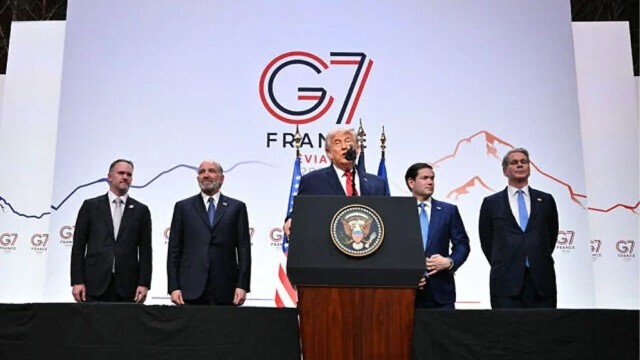
PARIS, Jun 18 (V7N) – U.S. President Donald Trump has said it is “unfair” for Iran to be denied ballistic missiles while neighboring countries possess similar weapons, offering a notable shift in tone on Tehran’s missile program during remarks at the G7 summit in France.
Speaking at a press briefing on the sidelines of the summit on Wednesday, just before a new U.S.–Iran memorandum of understanding came into effect, Trump argued that Iran should be allowed to maintain a proportionate missile capability.
“If Saudi Arabia, Qatar and others have them, then Iran should have some proportionally,” Trump said, according to The Times of Israel.
He added that ballistic missiles, while destructive, are limited in scope compared to nuclear weapons, which he described as posing a far greater global threat.
Trump also claimed that without the newly signed agreement, military escalation against Iran could have continued for several more weeks, warning that such a scenario risked triggering the closure of the Strait of Hormuz and causing a severe global economic crisis.
“The market would have fallen to levels never seen before. We have averted an economic disaster,” he said.
The comments came shortly before the formal implementation of a U.S.–Iran memorandum of understanding, which was later confirmed by Iran’s Foreign Ministry. A U.S. official stated that the agreement was initially signed digitally last Sunday by Vice President J.D. Vance and Iranian negotiator Mohammad Bagher Ghalibaf, before receiving final approval from Trump and Iranian President Masoud Pezeshkian.
Under the agreement, Iran is not required to immediately surrender its stockpile of highly enriched uranium. Instead, the issue will be addressed through a structured process over the next two months, potentially involving gradual reductions in enrichment levels under the supervision of the International Atomic Energy Agency (IAEA).
The deal marks a temporary easing of tensions between Washington and Tehran, while broader negotiations are expected to continue in the coming weeks, particularly on Iran’s nuclear program and regional security concerns.
Officials on both sides say the agreement is intended as a confidence-building step, though major disagreements remain unresolved.
END/SMA/AJ