Washington, Jun 24 (V7N)- The United States Senate has approved a War Powers Resolution aimed at restricting President Donald Trump from launching new military action against Iran without explicit authorization from Congress.
The resolution passed the Senate on Tuesday (June 23) by a vote of 50-48, following earlier approval by the House of Representatives. The vote marks the first time a War Powers Resolution concerning Iran has been passed by both chambers of Congress during Trump's presidency.
Despite Republicans holding a majority in the Senate, four Republican senators crossed party lines to support the measure. They were Bill Cassidy, Lisa Murkowski, Susan Collins and Rand Paul. Meanwhile, Republican senators Mitch McConnell and Dave McCormick did not participate in the vote.
Among Democrats, only John Fetterman voted alongside most Republicans in opposition to the resolution.
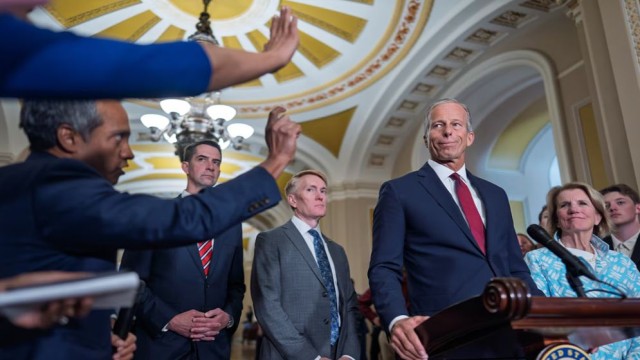
Speaking on the Senate floor, Senate Democratic Leader Chuck Schumer criticized the administration’s Iran policy, arguing that military escalation had created uncertainty and increased costs for the American public. He described the conflict as a major foreign policy mistake and accused many Republican lawmakers of prioritizing loyalty to the president over public concerns.
The resolution comes amid continuing tensions following the Trump administration's military campaign against Iran, including the operation known as "Operation Epic Fury," launched earlier this year in coordination with Israel. The administration has maintained that its actions were necessary to prevent Iran from developing nuclear weapons, a claim that Tehran has consistently denied.
Meanwhile, diplomatic efforts continue in Switzerland, where U.S. and Iranian officials are engaged in talks aimed at implementing a ceasefire framework based on a memorandum of understanding signed on June 17. However, uncertainty remains over the durability of the agreement amid ongoing regional tensions.
Supporters of the resolution argue that under the U.S. Constitution, the authority to declare war belongs to Congress and not the president alone. Democratic Senator Tim Kaine emphasized that the nation's founders intentionally vested war-making powers in the legislative branch to prevent such decisions from being concentrated in the hands of a single individual.
The White House is expected to oppose the measure, and President Trump has signaled that he may veto the bill if it reaches his desk. If vetoed, Congress would require a two-thirds majority in both chambers to override the president's decision.
The vote reflects growing debate in Washington over executive authority, military intervention, and the future direction of U.S. policy toward Iran amid rising public concern over the economic and geopolitical costs of the conflict.
END/SMA/AJ