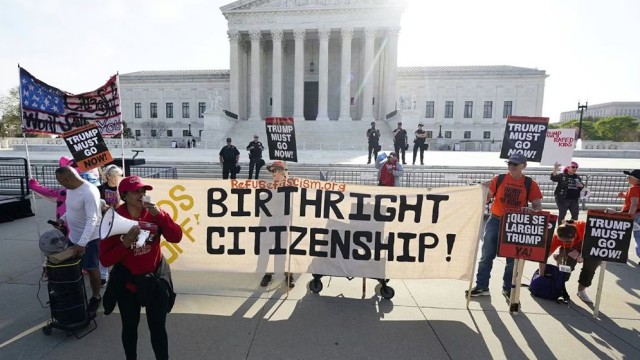
Washington, Jul 01 (V7N) — The Supreme Court of the United States has rejected President Donald Trump's attempt to end birthright citizenship, ruling that every child born in the United States is automatically a U.S. citizen regardless of their parents' immigration status.
In a 6-3 decision, Chief Justice John Roberts wrote that the Fourteenth Amendment to the United States Constitution guarantees citizenship to all children born on U.S. soil, including those whose parents are in the country illegally or on temporary visas.
The ruling blocks Trump's executive order, issued after returning to office, which sought to restrict birthright citizenship. His administration argued that children born to undocumented immigrants or temporary visa holders were not fully subject to U.S. jurisdiction and therefore should not automatically receive citizenship.
Rejecting that interpretation, the court reaffirmed that birthright citizenship is a constitutionally protected right.
"The right to citizenship is a fundamental right," Roberts wrote in the majority opinion. "It allows a person to be a full part of our society. The framers of the Fourteenth Amendment made this promise to every free person born in this country. We continue to uphold that promise today."
Reacting to the decision, President Trump described it as "a very sad decision" in a social media post and vowed to continue pursuing changes through legislation rather than executive action.
"This does not require a long and complicated constitutional amendment," Trump wrote. "Congress should begin the work of abolishing this costly and unfair system of birthright citizenship today."
Birthright citizenship has been a constitutional principle in the United States since 1868, when the Fourteenth Amendment was adopted following the Civil War to guarantee citizenship rights to formerly enslaved people. The Supreme Court has repeatedly upheld the principle in subsequent rulings.
The court's three conservative dissenters—Justices Clarence Thomas, Neil Gorsuch and Samuel Alito—argued that the majority had interpreted the Fourteenth Amendment too broadly.
Thomas said the amendment was being applied beyond its original intent, while Alito warned that the ruling would allow nearly anyone born in the United States to obtain citizenship, including children born to parents who entered the country temporarily.
The decision was welcomed by immigrant rights and civil liberties organizations. Hakeem Jeffries said the court had reaffirmed the Constitution by confirming that all people born in the United States are American citizens.
Meanwhile, civil rights attorney Darieli Rodriguez said the ruling reinforces a constitutional principle that has stood for more than 150 years, emphasizing that every child born on U.S. soil is entitled to American citizenship regardless of their parents' legal status.
Legal analysts say the ruling represents a significant setback for the Trump administration's hardline immigration agenda while reaffirming one of the longest-standing constitutional protections in the United States.
END/SMA/AJ