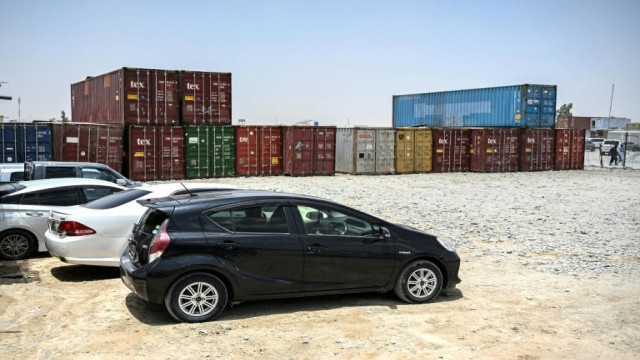
SPIN BOLDAK, Afghanistan, July 5, (V7N) — In Afghanistan’s southern Kandahar province, a once-thriving trade in imported car parts has come to a standstill due to conflicts at the country’s borders.
The Spin Boldak market first slowed when cross-border violence with neighboring Pakistan led to the near-total closure of the frontier in October.
"When the border was closed with Pakistan, we also exported via (Iran's) Bandar Abbas port with many difficulties... but there was still a way," said Abdul Baqi Bina, deputy head of the Kandahar Chamber of Commerce and Investment.
Vehicle parts from Japan and elsewhere that previously reached Spin Boldak overland through Pakistan were rerouted through the United Arab Emirates, a longer and costlier route that at least kept business running.
But the Middle East war that broke out in February “created very difficult problems for Afghanistan,” Bina said.
The conflict caused major disruption to international trade through the Strait of Hormuz, and shipping companies have warned that restoring normal operations through the vital waterway will take time.
Parts that reached Spin Boldak before the wars were assembled into new cars on site or distributed nationwide for repairs.
Asadullah, who goes by one name, imported from Dubai and Japan and said the conflicts have "paralysed business" for months.
"We opened two containers every day in the yard," he said from his office. The price per container jumped from about $2,000 to $8,000 after the Middle East war began, the 40-year-old told AFP.
Asadullah said he currently has more than 30 containers stuck in Japan and the UAE, largely due to delays at Dubai’s Jebel Ali port, a key logistics hub.
The World Bank in May described Afghanistan as "highly exposed to external shocks," with a "widening gap between imports and exports" that reached 70 percent of GDP in the 2025 fiscal year.
'It's a total loss'
Masoud, who imports parts from Japan, said he has had no business "since the beginning of the war" in Iran.
"We used to import dozens, even hundreds of containers (monthly)... but now it's down to zero," he told AFP beside a calculator and his accounting book.
Some of his containers reached the UAE, but he has started shipping them back to Japan because of mounting storage costs.
"We have no other option. I don't see any alternative way; it's a total loss," said Masoud, who does not have a surname.
The disruption has affected thousands of workers at the Spin Boldak market, including crane operator Mohammad Naeem.
"I'll have to leave this line of work and start to do something else" if the situation does not improve, the 21-year-old said.
In dark workshops where cars were once built, men sit idle alongside unused tools and wheels.
Samiullah, a 30-year-old workshop owner who uses one name, said they used to make "five to seven cars per week" but work has stopped because no new parts are arriving.
"If it continues like this, we will have nothing to do; we will sustain more and more losses," he said, noting he still has to pay employees.
At a car showroom in the market, owner Noor Ali was surrounded by a dozen colorful vehicles built with imported Japanese parts.
"As few containers are coming to Spin Boldak, customers have decreased," he said, a month since his last sale.
"Hopefully they reach an agreement and (fully) open the Strait," he said, standing beside his unsold vehicles.
END/WD/RH