


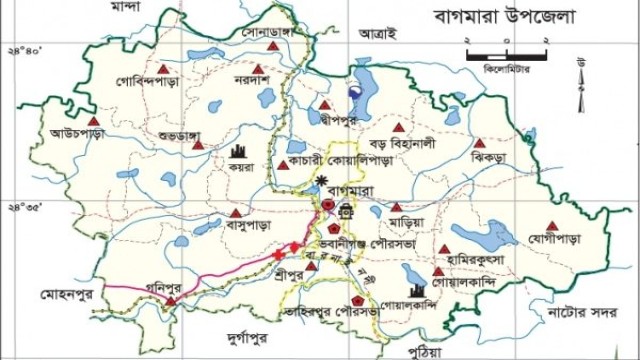
Rajshahi, Jan 26 (V7N) — Bagmara upazila of Rajshahi district, comprising 16 unions and two municipalities, is regarded as one of the region’s traditional and administratively important areas. However, since August 5, Bagmara—like many parts of the country—has remained without elected public representatives. As a result, all administrative activities are currently centered on the upazila executive administration, a situation that local residents allege has opened the door to widespread irregularities across various government offices.
One of the most serious allegations involves the Upazila Food Office, where irregularities in food grain procurement allegedly led to the embezzlement of nearly Tk 70 million. In this incident, only one official—Bachchu Mia, a sub-inspector of the Bhabaniganj food warehouse—has reportedly been punished. Locals claim that such a large-scale financial crime could not have been carried out by a single individual and argue that senior officials of both the Food Department and the Upazila Administration cannot evade responsibility. According to them, discrepancies in commission-sharing exposed the matter, turning one official into a scapegoat.
Further allegations point to misuse of development funds within the Upazila Administration premises. A government-owned pond inside the upazila complex reportedly had a minor water hyacinth problem. Despite eyewitnesses estimating that the cleaning could have been completed for around Tk 10,000, a so-called coordinator allegedly received a budget allocation exceeding Tk 100,000 with the approval of the Upazila Nirbahi Officer. When a comment questioning this allocation was posted in a trusted local online group, the commenter was reportedly forced to delete the message immediately.
Questions were also raised on December 16, 2025, during Victory Day celebrations, when several upazila officials appeared wearing identical traditional panjabis. Locals questioned the source of funds used to procure the outfits. On the same occasion, a teenage student reportedly shouted slogans accusing the administration of dishonesty and later posted criticism online. Sources allege that the student was subsequently harassed in various ways.
Financial transparency regarding public funds has also come under question. During the 2024–2025 fiscal year, more than Tk 27.4 million remained as unspent revenue, allocated in the name of elected representatives and various institutions. However, allegations suggest that the Upazila Administration demanded a 10–20 percent commission against fund allocations. In unions where elected chairmen were absconding or temporarily suspended, acting chairmen—administrators or members—were reportedly pressured into compliance. Their project bills were swiftly cleared after agreeing to unofficial conditions.
In contrast, BNP-supported chairmen who protested these practices on social media allegedly faced delays and repeated inspections in the approval of their project bills. Among them were Bihanali Union Parishad Chairman Mahmudur Rahman Milon and Auchpara Union Parishad Chairman Safikul Islam Safi. A social media post by Chairman Milon criticizing the administration reportedly sparked widespread debate across the upazila.
The Upazila Nirbahi Officer also serves as the administrator of Taherpur Municipality, a first-class municipality. After assuming responsibility, the UNO reportedly cancelled leases of government land previously allocated in the name of a local college. In protest, students, teachers, guardians, business owners, and civil society representatives of Taherpur organized a human chain demanding the removal of the UNO. Meanwhile, the assistant commissioner (land) currently holds administrative responsibility for Bhabaniganj Municipality.
Controversy further escalated during the recent recruitment of village police (chowkidars) in Bagmara. According to a Facebook post by Bihanali Union Parishad Chairman Mahmudur Rahman Milon, public money was allegedly collected openly at the UNO’s office for recruitment purposes. The post claimed that while a formal viva board—including respected officials—conducted interviews inside, agents outside collected large sums of money from poor candidates under the guise of “table money.”
Speaking on the issue, Chairman Milon said he posted on social media to protest the ongoing irregularities. He expressed frustration that honest chairmen and members do not receive project payments on time, are subjected to repeated inspections, and are not informed whether their work meets required standards. He also claimed to be aware of instances where 11 percent commissions were taken from two acting chairmen.
Milon further alleged that allowances meant for around 1,600 social welfare beneficiaries disappeared overnight, and that genuine farmers are deprived of fertilizers at fair prices. He said such situations would not arise if the Upazila Administration exercised stricter oversight.
Sources also claim that officials previously listed under the former “fascist” government may be involved in managing the upcoming national parliamentary election. It has been alleged that all departmental activities are implemented only with prior approval from the Upazila Nirbahi Officer.
Investigations reveal that for the upcoming 13th parliamentary election, presiding officers, assistant presiding officers, and polling officers have allegedly been appointed predominantly from among teachers and staff aligned with the ruling Awami League. When contacted on his official mobile phone, Bagmara Upazila Nirbahi Officer Mahbubul Islam said that election personnel were appointed based on reports from various intelligence agencies. Responding to other allegations, he stated that cases have already been filed regarding fertilizer irregularities and the procurement of spoiled food grains. Regarding the remaining issues, he asked reporters to visit his office for face-to-face discussions.
END/MRA/SMA/










Comment: