Sunamganj, May 01 (V7N) — After five days of relentless rain, the sun has finally appeared over the haor region, bringing a glimmer of hope. However, for thousands of farmers, the damage has already been done.
Floodwaters have begun to recede slightly, but vast stretches of ripe paddy have been submerged and destroyed. Instead of the usual fragrance of golden harvests, the air across the haors is now filled with the smell of rotting crops and despair.
According to the Flood Forecasting and Warning Centre Bangladesh, the situation is unlikely to improve quickly. Officials warn that it may take weeks for flood conditions to normalize due to continued heavy rainfall and upstream water flow.
Massive Crop Loss Across Haor Belt
Initial estimates from the Department of Agricultural Extension Bangladesh indicate that around 180,000 hectares of paddy fields have been damaged across districts including Sunamganj, Kishoreganj, Netrokona, Habiganj, Sylhet, Moulvibazar, and Brahmanbaria.
Out of 455,153 hectares cultivated this season, only about 300,000 hectares have been harvested. The fate of the remaining crops remains uncertain.
In Sunamganj alone, nearly 14,000 hectares across 199 haors have already gone underwater, with only 51 percent of the harvest completed. In Kishoreganj, 6,768 hectares have been affected, impacting around 15,000 farmers, while in Moulvibazar, about 1,150 hectares have been submerged.
Farmers Struggle to Salvage What They Can
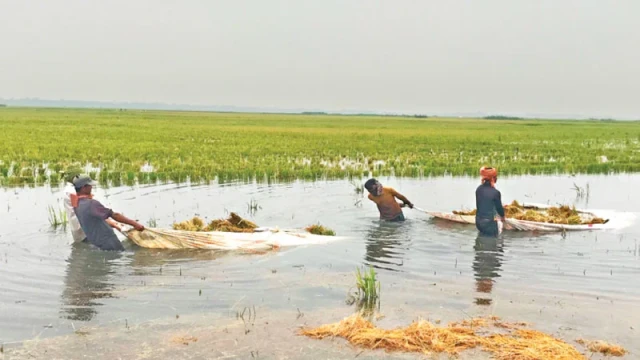
Despite the devastation, farmers are making desperate attempts to salvage whatever remains. Many are seen harvesting paddy while standing in knee-deep water, often without sufficient labor or machinery.
In villages like Buristhal and Kirttinagar, fields that once bustled with activity now lie silent. Farmers say even harvested paddy has rotted due to continuous rain and sprouting.
“We are drying whatever we can, but most of it is already spoiled,” said a local farmer, describing the situation as one of total loss.
Labor shortages have further complicated harvesting efforts. With rising wages—exceeding Tk 1,200 per day—and limited access to machinery due to waterlogging, many farmers are unable to recover their crops in time.
Weather Outlook Offers Little Relief
According to officials, heavy to very heavy rainfall may continue until May 6, followed by moderate rainfall until May 10, prolonging the crisis.
Economic Impact and Calls for Urgent Support
Agricultural economist Jahangir Alam warned that the disaster could significantly affect national rice production. He noted that the Boro season accounts for about 54 percent of the country’s total rice output, much of which comes from haor regions.
He emphasized the need for immediate government intervention, including:
-
Accurate damage assessment
-
Financial compensation and loan waivers
-
Distribution of free seeds and fertilizers
-
Deployment of harvesting machinery and labor support
He also called for long-term measures such as sustainable embankments, improved early warning systems, and climate-resilient crop varieties.
Government Response
Disaster Management and Relief Minister Asadul Habib Dulu said food and financial assistance will be provided to affected farmers under government directives.
Agriculture Secretary Rafiqul Islam Mohammad stated that additional officials have been deployed in affected areas. Efforts are underway to supply paddy drying machines and accelerate relief and rehabilitation activities.
END/SMA/AJ