


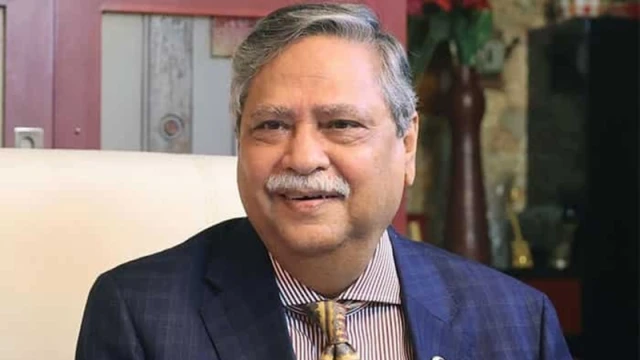
Dhaka, Dec 12 (V7N) – Bangladesh President Mohammed Shahabuddin said on Thursday that he plans to resign after the national election scheduled for February, stating that he felt insulted by the behavior of the interim administration headed by Nobel Peace Prize winner Muhammad Yunus.
Shahabuddin made the remarks in an interview with Reuters journalist Krishna N. Das, conducted via WhatsApp from Bangabhaban in Dhaka. He noted that this was his first media interview since assuming office.
The president confirmed that he has maintained regular contact with Army Chief General Waker-Uz-Zaman, but declined to say whether he had communicated with former prime minister Sheikh Hasina after the August uprising that forced her to flee to India.
Although the president is constitutionally the supreme commander of the armed forces, the position is largely ceremonial. Executive authority lies with the prime minister and the cabinet. However, after the student-led uprising that ousted Sheikh Hasina in August 2024 and dissolved parliament, Shahabuddin remained the only constitutional authority in the country, giving his office unusual significance.
Shahabuddin, who was elected unopposed in 2023 as the nominee of the Awami League, now sees his role as a temporary duty. The Awami League has been barred from contesting the February 12 election.
“I am eager to leave. I want to step down,” he said. “Until the election is held, I feel I should continue. Constitutionally I am maintaining the position because I hold the office of the president.”
He accused the interim government of sidelining him and diminishing the dignity of the presidency. According to Shahabuddin, Yunus did not meet him for nearly seven months. His press wing was taken from him, and in September, Bangladeshi embassies around the world removed his official portrait without explanation.
“All consulates, embassies and high commissions had the president’s picture. Suddenly, in one night, it was removed everywhere,” Shahabuddin said. “This sends the wrong message to the people, as if the president has been removed. I felt deeply insulted.”
He said he wrote to Yunus asking for action regarding the portraits, but received no response. “My voice has been suppressed,” he added.
Spokespersons for the chief adviser did not immediately respond to Reuters’ request for comment.
On questions about political communication, Shahabuddin acknowledged that he is in regular contact with General Waker-Uz-Zaman. During the protests in August, the military remained silent, which ultimately sealed the fate of the Awami League government. Shahabuddin said, “Waker-Uz-Zaman has made it clear that he has no intention of seizing power.” Although Bangladesh has a history of military rule, the army chief has publicly affirmed his commitment to democratic governance.
The president said that while some students initially demanded his resignation, no political party has asked him to step down in recent months.
Recent opinion polls suggest that the Bangladesh Nationalist Party (BNP), led by former prime minister Khaleda Zia, along with the Islamist Jamaat-e-Islami, holds the advantage in forming the next government. BNP and Jamaat previously governed in coalition between 2001 and 2006.
Asked whether he attempted to contact Sheikh Hasina after her departure from the country, Shahabuddin declined to answer. He said he has been independent and unaffiliated with any political party since assuming the presidency.
END/V7D/SMA/






Comment: