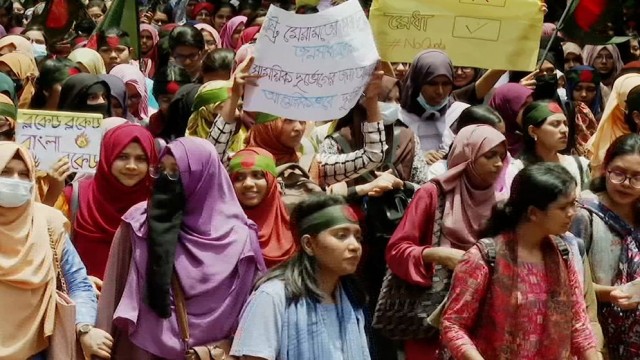
Dhaka, Jan 14 (V7N) — Despite women playing a frontline role in the July Uprising, breaking barriers and leading protests amid bullets with a clear stance against all forms of discrimination, their contribution has failed to translate into meaningful political representation in the upcoming 13th National Parliament election.
Ahead of the signing of the July Charter, the Consensus Commission proposed increasing women’s representation in parliament from 50 to 100 seats. While most political parties, including the two major parties, agreed in principle to increasing the number of reserved seats, they opposed the idea of direct elections for those seats.
Eventually, the BNP proposed that political parties nominate at least 5 percent women candidates in the 13th parliamentary election. Despite reservations from Islamist parties, a consensus was reportedly reached after negotiations.
However, the implementation has fallen far short of those commitments.
During scrutiny, the nomination papers of 1,842 candidates were declared valid, but only 65 of them were women. Notably, Jamaat-e-Islami did not nominate a single female candidate, a situation mirrored by 30 registered political parties, including Jamaat’s like-minded allies.
Although BNP nominated 10 women candidates, this represents only 3.4 percent, falling short of its own proposed 5 percent benchmark.
Among other parties, the Jatiya Party and the BSP (Marxist) each nominated nine women candidates, while the National Citizen Party (NCP)—formed by youth leaders of the July Uprising—nominated three women candidates.
Members of the Consensus Commission and election experts have expressed disappointment, saying that political parties have ignored both the spirit and substance of the July Charter with regard to women’s political participation.
Election expert Jasmine Tully said that women’s participation in nominations has been higher in past elections.
“There are many women who are active in movements and political struggles, yet they rarely make it to parliament,” she said. “In my view, parties often nominate women in constituencies where they are weak and have little chance of winning.”
Election analyst Dr. Badiul Alam Majumder termed the situation “sad and unacceptable.”
“Voters must question political parties about their commitments,” he said. “Only then will parties feel pressured to act responsibly on women’s representation.”
The disparity between women’s leadership during the July Uprising and their marginal presence in electoral politics has raised a pressing question: Can women’s leadership advance without genuine political will?
For now, observers say, the struggle for women’s political representation in Bangladesh remains unresolved.
END/SMA/AJ