


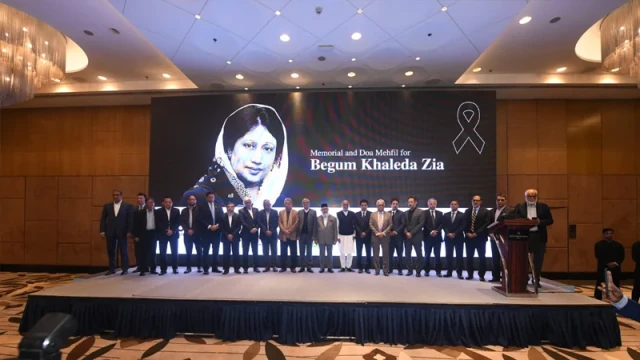
Dhaka, Jan 06 (V7N) - Bangladesh’s leading business figures have remembered former Prime Minister and BNP Chairperson Begum Khaleda Zia as an uncompromising leader who rose from an ordinary homemaker to a central figure in the country’s struggle for democracy and economic development. They said her lifelong commitment to public welfare, despite repeated imprisonment and persecution, was marked by resilience rather than vengeance.
The views were expressed at a discussion meeting and prayer session organized in memory of the late leader by the International Chamber of Commerce Bangladesh (ICCB), with the support of 17 business organizations. The event was held on Monday at a hotel in the capital and was chaired by ICCB President Mahbubur Rahman.
Speakers noted that Khaleda Zia advanced the free-market economic principles introduced by former President Ziaur Rahman, emphasizing private sector growth, business-friendly policies, and dialogue between the government and entrepreneurs. Under her leadership, they said, Bangladesh experienced steady economic growth and notable social progress, which contributed to long-term poverty reduction.
BNP Secretary General Mirza Fakhrul Islam Alamgir recalled that Khaleda Zia carried forward the legacy of multiparty democracy and market-based economics. Referring to her message to the nation following the August 5 student-led uprising, delivered despite serious illness, he said her call for unity, love, and reconciliation over revenge had reshaped the national political atmosphere.
BNP Standing Committee member Amir Khasru Mahmud Chowdhury said Khaleda Zia firmly believed that economic progress was impossible without democracy. He added that she promoted free-market policies and avoided overreliance on any single country in strengthening democracy and the economy. Another Standing Committee member, Dr. Moin Khan, said she fostered a unique balance between the public and private sectors, going beyond mere support for market liberalization.
ICCB President Mahbubur Rahman said Khaleda Zia’s political life was defined by strong leadership, courage, and a deep commitment to democratic values. He noted that during the 1990s and early 2000s, Bangladesh saw stable GDP growth, expansion of trade and investment, and greater integration with the global economy under her governments.
Business leaders from various sectors highlighted her contributions to garments, pharmaceuticals, banking, cement, capital markets, and emerging industries, describing her as a leader who listened more than she spoke and consistently engaged with entrepreneurs to address business challenges. They concluded that her vision of democracy, entrepreneurship, and hard work remains a guiding principle for Bangladesh’s economic and social development.
END/RKB/SMA/













Comment: