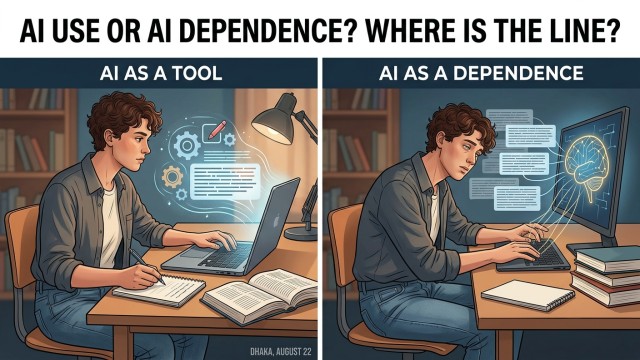
Dhaka, Aug 22 (V7N)- Artificial intelligence (AI) has rapidly become a personal assistant in everyday life. From correcting spelling and grammatical errors to improving sentence structure, understanding complex topics and generating new ideas, AI can save significant time and effort.
But as AI becomes increasingly accessible, an important question is emerging: Are we using AI as a tool, or becoming dependent on it?
The distinction is important.
Suppose someone writes an article based on their own knowledge, ideas and opinions and then uses AI to correct spelling and grammatical mistakes. AI can also help make unclear sentences more fluent or suggest better ways to present certain parts of the article.
This is an example of using AI as a tool. The main ideas, arguments and writing remain the person’s own, while AI simply helps refine the work.
The problem begins when AI starts replacing a person’s own thinking and effort.
AI use among students
The growing use of AI is particularly visible among students.
Students are increasingly using AI for assignments, presentations, research, translation and exam preparation. Previously, students generally searched for answers in textbooks, consulted teachers or browsed different websites.
Now, AI can provide a basic explanation of a topic within seconds.
This can be extremely useful when used properly. A student can use AI to understand a difficult concept, identify areas that require further study or organize ideas before beginning an assignment.
However, simply copying an AI-generated answer without understanding the subject can prevent students from developing their own analytical and writing skills.
The real concern is dependence
AI itself is not necessarily the problem. The concern is what happens when people stop thinking independently because an AI system can provide an answer instantly.
If a student uses AI to understand a difficult lesson and then solves the problem independently, AI has served as a learning assistant.
But if the student asks AI to complete every assignment and submits the response without reading or understanding it, the technology has replaced the learning process.
The same principle applies to writing, research and professional work.
AI can help people work faster and more efficiently. But human judgment, creativity, critical thinking and responsibility remain essential.
The goal, therefore, should not be to avoid AI. Instead, people should learn to use AI without allowing AI to replace their ability to think and create independently.
END/SMA/AJ