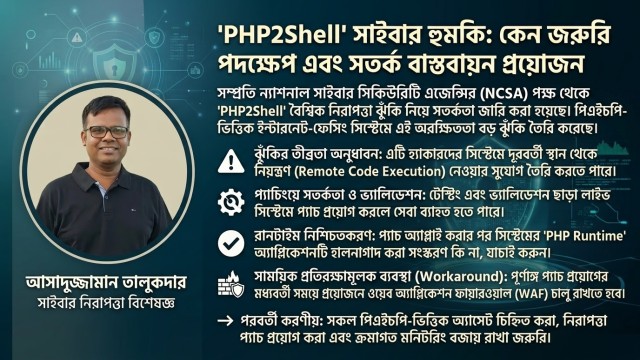
Dhaka, Oct 23 (V7N) – A newly disclosed pair of critical vulnerabilities in the PHP programming language has raised global cybersecurity concerns, prompting warnings from security agencies and urgent calls for organisations to identify vulnerable systems, install security updates and investigate possible signs of compromise.
Known collectively as “PHP2Shell,” the vulnerabilities could allow attackers to execute malicious code on affected web servers without authentication. They may also expose sensitive information or disrupt digital services, creating risks for government portals, financial platforms, e-commerce websites, business applications and other internet-facing systems that rely on PHP.
Bangladesh’s National Cyber Security Agency (NCSA) has issued a warning about the threat, while the Bangladesh Government Computer Incident Response Team (BGD-CIRT) and international cybersecurity organisations are assessing its potential impact and recommending mitigation measures.
The vulnerabilities were publicly disclosed on October 21, when the PHP development team released emergency security updates. The US National Security Agency (NSA) also issued an advisory urging organisations to identify affected systems and prioritise patching. The urgency reflects the broad use of PHP in websites and online services worldwide. <Cite refs={["turn669036search10","turn536911search9","turn669036search0"]}/>
What is PHP2Shell?
PHP is a server-side programming language used to build and operate websites and web applications. It underpins many widely used content management systems and online platforms, including WordPress, Drupal and Joomla.
PHP2Shell refers to two related vulnerabilities in the core PHP runtime rather than a flaw confined to one website, plugin or content management system. The issues are tracked as CVE-2026-109618 and CVE-2026-109619, and both have been assigned a critical severity rating of 9.2 under the Common Vulnerability Scoring System (CVSS) version 4.0. <Cite refs={["turn536911search0","turn536911search3","turn669036search10"]}/>
The vulnerabilities involve unsafe memory handling when PHP encounters certain errors while processing web requests. Under particular conditions, internal data may be left improperly initialised or references may remain to memory that has already been released. An attacker who successfully exploits these conditions may be able to manipulate the affected process.
The first vulnerability, CVE-2026-109618, involves memory corruption associated with out-of-memory handling. The second, CVE-2026-109619, involves stale internal state following a fatal error. Depending on the vulnerable configuration and execution path, exploitation may lead to remote code execution, memory disclosure or service disruption. <Cite refs={["turn536911search3","turn669036search0","turn669036search10"]}/>
Remote code execution is particularly serious because it can allow an attacker to run commands on a vulnerable server using the privileges available to the affected web process. This may provide a route to steal information, alter website content, install malicious tools, disrupt services or attempt to move deeper into an organisation’s network.
The potential consequences depend on the server’s configuration, the permissions assigned to the web application and the data accessible to the compromised process. A successful attack does not automatically mean an attacker has gained full administrative control of the entire network, but it can create a significant foothold from which further attacks may be attempted.
Why the vulnerabilities are especially concerning
One of the most important characteristics of PHP2Shell is that exploitation may not require an attacker to log in or compromise a particular application account first.
According to the PHP development team’s security announcement, the vulnerabilities can allow unauthenticated remote code execution. The team has urged users to update immediately and stated that there are no complete mitigations that can replace installing the security updates. <Cite refs={["turn669036search7","turn669036search10"]}/>
This means organisations cannot assume that a website is safe simply because its application code has been carefully developed or its user login system is secure. The weakness is in the PHP runtime itself, which processes requests before or during the execution of application code.
A vulnerable server may therefore remain at risk even if its website has no known malicious plugin or obvious application-level security flaw.
The threat is relevant to a range of PHP deployments, including PHP-FPM, Apache configurations using mod_php, php-cgi and other web-serving environments. Organisations must identify the PHP version actually running their applications rather than relying solely on the version mentioned in source code, development documentation or a hosting control panel. <Cite refs={["turn536911search6","turn669036search0"]}/>
Global security agencies call for urgent action
The international response has focused on rapid vulnerability identification, patch deployment and monitoring for exploitation.
The US National Security Agency said organisations should maintain heightened awareness of internet-facing devices and services that rely on vulnerable PHP versions. Its advisory recommends conducting an inventory of affected systems, applying vendor security updates and enhancing logging. It also advises organisations to consider taking systems offline when they cannot be adequately protected while awaiting remediation. <Cite refs={["turn536911search9"]}/>
The PHP development team released patched versions of its supported branches on October 21. The available updates include PHP 8.5.12, 8.4.27, 8.3.36 and 8.2.35. Organisations should confirm the appropriate fixed release for their branch and follow the instructions of their operating-system distribution or hosting provider. Older PHP branches may no longer receive updates directly from the PHP project, although some vendors provide security backports. <Cite refs={["turn669036search10","turn669036search7"]}/>
Cloudflare, a major internet infrastructure and security provider, reported deploying web application firewall protections ahead of the public disclosure. Its security team said the vulnerabilities could be triggered by specially crafted HTTP traffic and that exploitation attempts could lead to code execution, information exposure or denial of service.
Cloudflare also emphasised that WAF protection should be treated as an additional layer of defence rather than a substitute for updating PHP. <Cite refs={["turn669036search0"]}/>
These advisories underline a central principle of incident prevention: organisations should not wait for evidence that their own systems have been attacked before addressing a critical vulnerability.
What does this mean for Bangladesh?
The vulnerability presents a potential risk to Bangladeshi organisations that operate public-facing websites, online portals and applications using affected PHP versions. These may include government service portals, educational institutions, hospitals, financial service providers, online businesses, media organisations and private companies.
However, the existence of the vulnerability does not establish that a particular Bangladeshi organisation has been compromised. The actual level of exposure depends on the software version in use, the server architecture, the availability of a security update and whether attackers have attempted or succeeded in exploiting the system.
For Bangladesh, the first priority should be to identify exposed PHP installations across government agencies, critical information infrastructure, service providers and private-sector organisations.
NCSA and BGD-CIRT can play important roles in communicating technical guidance, coordinating incident reporting and helping affected organisations assess their exposure. Organisations should follow the latest official advisories and vendor-specific instructions rather than relying on informal social media posts or unverified vulnerability-checking services.
The risk also extends to websites hosted by third-party providers. An organisation may own its website and manage its content without directly controlling the underlying PHP runtime. In such cases, the organisation should promptly contact its hosting provider, obtain confirmation of the deployed PHP version and request written confirmation that the security update has been applied.
A hosting provider’s general statement that its servers are secure should not replace verification that the affected runtime and all relevant instances have been updated.
Immediate action: Identify, patch and verify
Cybersecurity specialists recommend a structured response rather than applying updates without preparation or assuming that one successful update resolves every exposure.
1. Identify all PHP-based assets.
Organisations should prepare an inventory of public-facing websites, application programming interfaces, upload services, internal portals and other systems that process web requests through PHP.
The inventory should include production servers, backup environments, disaster-recovery systems, development and testing environments, containers, virtual machines and cloud deployments. Administrators should also identify systems operated by third-party service providers.
The assessment should determine the exact PHP version, the way PHP is integrated with the web server, the operating system and package source, and whether the installation remains supported.
2. Prioritise internet-facing and critical services.
Publicly accessible systems should receive urgent attention, especially those handling personal information, financial transactions, authentication credentials, government records or other sensitive data.
Security teams should prioritise systems running vulnerable versions and those that cannot be promptly isolated from the internet. Unsupported PHP installations require particular attention because a standard update may not be available from the original project.
3. Apply the appropriate security update.
Administrators should obtain patches through official PHP releases or the relevant operating-system and hosting vendor. The fixed versions identified in the October 21 release include PHP 8.5.12, 8.4.27, 8.3.36 and 8.2.35. <Cite refs={["turn669036search10"]}/>
Updates should be tested in a staging environment where feasible, particularly for applications that support essential public services. Testing should cover normal website functions, authentication, file uploads, database connectivity, background jobs and other business-critical processes.
Testing must not become a reason for indefinite delay. For a critical, internet-facing vulnerability, organisations should use an expedited change-management process with a defined deadline and an approved rollback plan.
4. Verify the runtime after patching.
Installing a package does not necessarily prove that every application is using the patched version. A server may have multiple PHP installations, separate PHP-FPM pools, container images, application workers or services that continue running an older runtime.
After updating, administrators should restart the relevant PHP processes and services when required by the vendor’s instructions. They should then verify the version running in production, confirm that the updated package is active and check that all application instances have received the fix.
Verification should cover load-balanced servers, containers and failover systems, not just the primary server.
5. Keep protective measures in place while remediation is completed.
Where immediate patching is not possible, organisations should reduce exposure through temporary protective controls. These may include a properly configured web application firewall (WAF), restrictions on unnecessary public access, tighter controls over file uploads and additional monitoring of web requests.
Cloudflare has described deploying PHP2Shell-specific WAF protections, illustrating how edge security controls can help reduce exposure. However, protection depends on the deployed service, rule configuration and traffic path. A WAF should not be assumed to block every possible exploit variant. <Cite refs={["turn669036search0"]}/>
The PHP development team has explicitly stated that no complete mitigation replaces updating the vulnerable runtime. Where an exposed system cannot be patched or adequately protected, organisations should consider restricting public access or taking it offline until the risk is addressed. <Cite refs={["turn669036search10","turn536911search9"]}/>
Monitoring for possible exploitation
Patching protects against exploitation of the known vulnerabilities after the relevant fix is properly deployed. It does not, by itself, establish whether an attacker gained access before the update.
Security teams should therefore review web server, PHP, application, operating-system, endpoint detection and network logs for suspicious activity around the period before and after disclosure.
Indicators requiring investigation may include unexpected child processes launched by web server or PHP workers, unfamiliar executable files, unexplained changes to website files, unusual outbound connections, suspicious account creation, unexpected access to sensitive files, abnormal server resource consumption or repeated errors associated with web requests.
These observations are not, on their own, proof of PHP2Shell exploitation. They should be assessed alongside timestamps, request records, process activity and other available evidence.
Monitoring should continue after patching. Security teams should also review whether suspicious activity occurred on systems that were subsequently updated, because an attacker may have installed persistence mechanisms or stolen credentials before remediation.
If compromise is suspected, organisations should preserve logs and relevant evidence, isolate affected systems where necessary, investigate the scope of the incident and rotate credentials or secrets that may have been exposed. Recovery should follow a documented incident-response plan rather than simply restoring normal service and assuming the threat has disappeared.
Protecting sensitive data and essential services
The consequences of a successful server compromise can extend beyond the website itself. Depending on the permissions and network access available to the affected process, an attacker may be able to access stored information, application secrets or credentials used to connect to other systems.
Organisations should review access controls and ensure that web applications operate with the minimum permissions necessary. Database accounts should not have unnecessary administrative privileges, and sensitive services should not be directly accessible from a compromised web server unless required.
API keys, database passwords, signing keys and other secrets should be stored securely and restricted to authorised services. If there is credible evidence that a server was compromised, potentially exposed credentials should be rotated from a trusted environment.
Backups should be protected from unauthorised modification and separated from ordinary production access. Organisations should also test recovery procedures to ensure that they can restore essential services without reintroducing vulnerable software or compromised files.
For government agencies and critical service providers, continuity planning is particularly important. Emergency updates should be coordinated with operational teams so that systems can be secured without avoidable disruption to essential public services.
What website owners and ordinary users should do
Although PHP2Shell primarily requires action by system administrators and hosting providers, website owners and users can take practical steps to reduce their exposure.
Website owners should contact their technical teams or hosting companies and ask four questions:
-
Is the website running an affected PHP version?
-
Has the appropriate vendor security update been installed?
-
Have all production servers, containers and PHP workers been updated and verified?
-
Have logs been reviewed for possible exploitation before the update?
Users should remain alert to unusual account activity, unexpected password-reset messages, suspicious transactions and notifications about unauthorised access. They should use unique passwords and multifactor authentication where available. These measures do not fix PHP2Shell, but they can reduce the impact of some forms of account compromise.
Users should also be cautious about links claiming to provide a quick PHP2Shell security test. Unverified websites may collect domain information, encourage unsafe downloads or provide misleading results. Technical testing should be conducted by authorised personnel using trusted tools and controlled procedures.
Expert assessment: Speed must be matched by verification
The official PHP security announcement and the advisories issued by the NSA and major security providers point to the same conclusion: this is a vulnerability requiring urgent technical remediation, not simply a routine software-maintenance task. <Cite refs={["turn669036search10","turn536911search9","turn669036search0"]}/>
The key challenge for organisations is to establish what is actually running in production, update every affected instance and confirm that the fix is active. A patch applied to one server does not protect a separate application instance that continues using a vulnerable runtime.
Security teams must also distinguish between vulnerability remediation and incident response. The first addresses the technical weakness; the second determines whether the weakness was exploited and whether any data, credentials or services were affected.
The response should therefore combine rapid patching, runtime verification, log analysis, access-control reviews and coordinated communication between system owners, hosting providers and incident-response teams.
The way forward for Bangladesh
For Bangladesh, PHP2Shell is a reminder that digital security depends not only on developing online services but also on maintaining the underlying software throughout its operational life.
Government agencies, financial institutions, telecommunications companies, educational organisations, hospitals, media outlets and private businesses should establish clear responsibility for vulnerability management. This includes maintaining an accurate asset inventory, subscribing to official security alerts, setting deadlines for critical patches and documenting the results of remediation.
NCSA and BGD-CIRT can support this process by distributing verified technical guidance, coordinating incident reporting and encouraging affected organisations to share relevant threat information through appropriate channels.
Organisations should also ensure that unsupported software is replaced or covered by a legitimate vendor-supported security arrangement. Repeatedly postponing upgrades can leave systems exposed to future vulnerabilities as well as the current threat.
PHP2Shell does not mean every PHP website has been attacked, nor does it establish that a particular organisation has suffered a breach. It does mean that organisations using affected versions must urgently determine their exposure and take appropriate action.
The immediate priorities are clear: identify vulnerable PHP assets, apply the correct security update, verify the running runtime, maintain protective controls during remediation and investigate suspicious activity. For systems that cannot be adequately protected, restricting access or temporarily taking them offline may be necessary.
As more public and private services move online, the ability to respond quickly and accurately to critical vulnerabilities is essential to protecting sensitive information, maintaining public trust and ensuring the continuity of Bangladesh’s digital services.
END/ATN/SMA/