Hangzhou, Aug 19 (V7N)- Chinese robotics company Unitree is increasingly challenging US manufacturers by developing robots with advanced features at significantly lower prices.
Headquartered in Hangzhou in eastern China, Unitree operates in a region that has emerged as a major hub for robotics companies. The industry has benefited from substantial government investment as Beijing seeks to strengthen China’s position in advanced technologies.
According to state-run China Daily, the number of robotics companies in China more than tripled between 2020 and 2024.
Fei Qin, an associate professor at the University of Bath, said China’s aging population could create labor shortages in the future, making robots a potential solution. He said Beijing considers robotics a “strategic priority” as it seeks technological leadership.
“Robots are a means through which AI can emerge from the shadows and enter the economy,” Qin said, noting that robots could eventually become widely used in factories, hospitals and homes.
Harold So, a researcher at the National University of Singapore, said US-made robots generally have more user-friendly software. However, he said the significantly lower prices of Chinese robots are difficult to overlook.
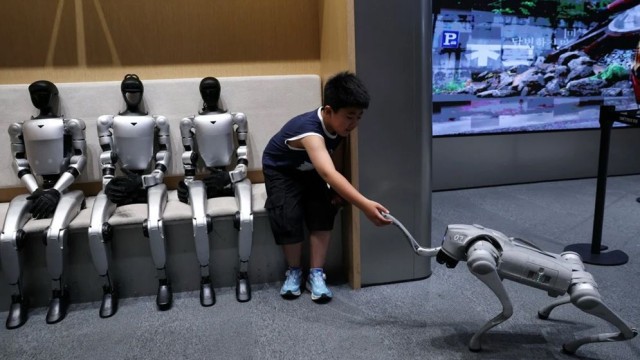
Unitree’s robot dogs start at around $2,700, while Boston Dynamics’ four-legged Spot robot costs approximately $70,000. So cautioned that the two products are not directly comparable because some Unitree models are considerably smaller, but he acknowledged that the price gap remains substantial.
Unitree has been selling humanoid robots since 2023. Its child-sized G-1 humanoid robot, scheduled for release next year, is priced at around $13,500.
Meanwhile, major US competitors, including Elon Musk’s Tesla, have yet to begin commercial deliveries of their competing humanoid robots.
Unitree has also attracted considerable attention ahead of its planned initial public offering. Its robots are participating this week in the 2026 World Humanoid Robot Games in Beijing, where hundreds of teams are competing in events including running and football, as well as practical tasks such as opening boxes and sorting library books.
Earlier in February, Unitree’s G-1 robot drew widespread attention after performing a martial arts demonstration at China’s Spring Festival Gala.
Robotics researcher David Su said the robots demonstrated techniques that had not previously been seen, describing the performance as evidence of the rapid development of China’s robotics industry.
According to Su, Chinese robotics companies have increasingly taken the spotlight from their US counterparts and are now becoming the “cool kids” of the global robotics industry.
END/SMA/AJ