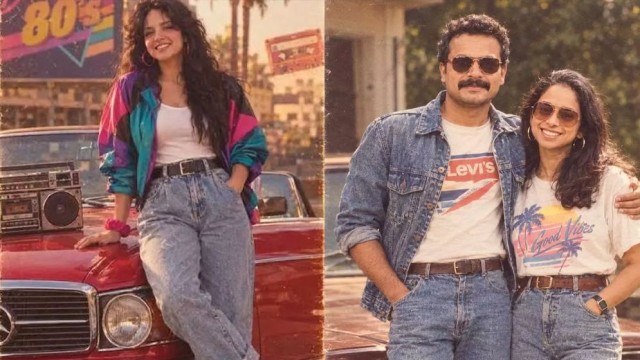
Dhaka, Sep 09 (V7N)- Imagine opening an old photo album and finding yourself dressed in 1980s-style clothes, with an era-appropriate hairstyle, standing on a familiar street from decades ago. The faded colors and film-like grain make the picture look as though it was taken nearly 40 years ago.
But there is a catch—the photograph may never have existed.
Artificial intelligence (AI) is now making it possible to recreate such scenes. Social media platforms, particularly Facebook, are being flooded with AI-generated images in which users transform their modern photographs into retro-style pictures inspired by the 1980s.
Some recreate themselves in the fashion of that era, while others place themselves in old streets, homes or social settings. Friends and family members are also being digitally brought together in scenes that may never have occurred in real life.
Technically, these are AI-generated images. But for many social media users, they represent something more emotional—a way of digitally revisiting a lost or imagined past.
Why the 1980s?
The answer lies largely in nostalgia.
For many people, the 1980s are associated with cassette tapes, VCRs, film cameras, colorful clothing, distinctive hairstyles, old movie posters, neighborhood stores and leisurely conversations.
The visual imperfections of photographs from that era have also become part of their appeal. Film grain, faded colors, distinctive lighting and the texture of old cameras can now be recreated by AI with remarkable realism.
Interestingly, this nostalgia is not limited to people who actually lived through the 1980s. Many younger people who were not even born during the decade are also embracing its visual style.
In this sense, AI is creating not only nostalgia based on personal memories but also an imagined memory of an era.
How does AI create an old photograph?
The process generally begins with a person's existing photograph and a set of instructions describing the desired era and atmosphere.
Users can specify 1980s clothing, hairstyles, streets, furniture, camera effects, lighting and color tones. AI then reconstructs the surroundings and appearance while attempting to retain the person's recognizable facial characteristics.
As a result, someone can appear in a place or period where they were never actually present—creating a form of digital time travel.
Are photographs still proof?
For generations, photographs were regarded as powerful evidence that an event had actually happened. A picture could serve as a visual record of a person, place or moment.
Generative AI is now challenging that assumption.
It is possible to create convincing images showing people at events they never attended or in places they never visited. In many cases, the images can look realistic enough to make it difficult to distinguish them from genuine photographs simply by looking at them.
This has made the question of authenticity increasingly important on social media.
Technology companies are therefore developing systems to identify and label AI-generated content. Meta, for example, has introduced an “AI Info” label for certain AI-generated images shared across Facebook, Instagram and Threads.
As AI-generated photography becomes increasingly sophisticated, the question is no longer simply whether an image looks real.
The bigger question is: Did it really happen?
END/SMA/AJ