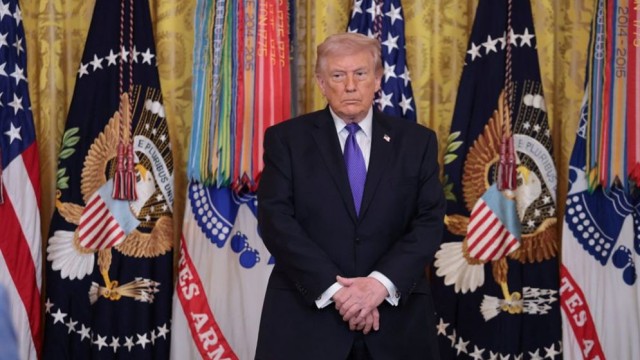
Washington, Apr 28 (V7N) — US President Donald Trump is facing growing political pressure at home as uncertainty continues over ongoing tensions and peace negotiations with Iran, with a key legal deadline approaching on May 1 that could shape the future of US military involvement.
Under the War Powers Resolution of 1973, the president is required to seek Congressional approval to continue military operations beyond a specified timeframe. If approval is not secured, US forces may be legally required to end the operation.
To extend authorization, a joint resolution must pass both the House of Representatives and the Senate by a simple majority. However, no such approval has yet been obtained.
Legal experts note that if the president seeks to extend military action beyond 60 days, he must notify Congress in writing, citing reasons such as “compelling military necessity.” Failure to act within the 90-day limit would obligate Congress to halt the deployment unless new authorization is granted.
Mariam Jamshidi, an associate professor at Colorado Law School, said Congress technically has the authority to terminate military deployments, although enforcing this provision in practice remains legally and politically complex. She noted that several past presidents have challenged or ignored parts of the law, arguing it is unconstitutional.
Meanwhile, opposition lawmakers have intensified efforts to block continued military operations. Democrats are preparing to force another vote in the Senate on war powers legislation this week, marking the sixth such attempt.
Senate Minority Leader Chuck Schumer criticized the administration on social media, questioning whether Republicans would continue to support what he described as a prolonged and “reckless war” after 60 days of military engagement.
Under the US Constitution, the authority to declare war rests with Congress, not the president. Democrats have repeatedly attempted to require congressional approval for military action and to limit future strikes without legislative consent.
The debate comes at a critical time, as diplomatic efforts regarding Iran remain uncertain and domestic political divisions over foreign policy continue to deepen.
END/SMA/AJ