


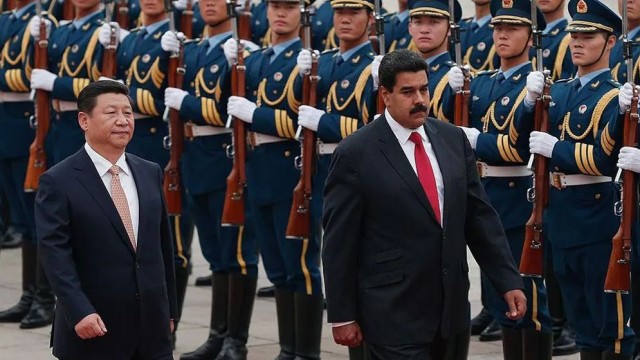
Beijing, Jan 07 (V7N) – The US military operation that led to the capture of Venezuelan President Nicolás Maduro has abruptly dismantled a relationship that China spent decades cultivating, sending shockwaves through Beijing’s strategic calculations in Latin America.
Just hours before his arrest by US forces at midnight on Saturday (January 3), Maduro had referred to Chinese President Xi Jinping as his “big brother” during a meeting with senior diplomats in Beijing. He praised Xi’s leadership and China’s global role, underscoring the depth of the Caracas–Beijing alliance.
China has long been one of Venezuela’s closest partners, investing heavily in the country’s oil sector and financing major infrastructure projects. State media recently broadcast images of officials from both nations reviewing nearly 600 bilateral agreements. Those scenes were quickly eclipsed by dramatic footage of Maduro blindfolded and handcuffed aboard a US warship.
The US operation drew condemnation from several countries, including China. Beijing accused Washington of acting as the “judge of the world” and stressed that international law must guarantee the sovereignty and security of all nations.
Yet beyond strong rhetoric, Chinese policymakers are now grappling with a more complex challenge: how to preserve influence in South America while managing an increasingly unpredictable relationship with President Donald Trump. Analysts say the incident marks an unexpected escalation in the US–China power rivalry.
While some observers view the crisis as an opportunity for Beijing to expand its diplomatic role, it also brings significant risks, uncertainty and frustration. China has traditionally sought to operate within established international rules—norms that many in Beijing believe the Trump administration has repeatedly undermined.
Beijing favors long-term planning and stability, but chaos has become a recurring feature of Trump’s second term. Although China is prepared for trade disputes, the Venezuelan operation presents a new kind of challenge—one rooted in direct geopolitical confrontation.
Trump’s move against Venezuela’s leadership has intensified Chinese suspicions of US intentions, particularly regarding efforts to curb Beijing’s global reach. US Secretary of State Marco Rubio reinforced that message in an interview with NBC on Sunday (January 4), saying, “We will not allow this region to become a base for US adversaries or competitors.”
Analysts interpret the statement as a blunt warning to China to stay out of Washington’s perceived sphere of influence.
Although Beijing has refrained from an official response, Chinese analysts and social media users are closely watching developments. The episode has sparked debate over Taiwan, which China considers a breakaway province. President Xi has vowed eventual reunification and has not ruled out the use of force. Some voices in China are asking: if Washington can conduct a military operation in Caracas, why could Beijing not do the same elsewhere?
However, analysts caution against such comparisons. According to geopolitical analyst David Sachs, China would act on Taiwan only if it believed military action would succeed at an acceptable cost—not simply because the US set a precedent.
Economically, the fallout is complex. Last year, around 80 percent of Venezuela’s oil exports went to China, but that accounted for only about 4 percent of China’s total oil imports. Even so, Chinese companies face potential risks to their investments and assets in Venezuela.
As the situation unfolds, Beijing faces a delicate balancing act: maintaining its strategic foothold in Latin America without jeopardizing recent trade agreements with the United States. Navigating that equation—especially with an unpredictable US president—may prove to be one of China’s most difficult foreign policy tests in years.
END/SMA/AJ









Comment: