


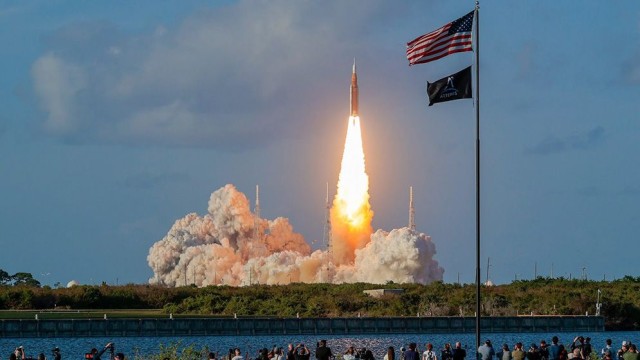
FLORIDA, Apr 02 (V7N) — For the first time in over half a century, humanity has embarked on a journey back to the Moon. NASA’s massive Space Launch System (SLS) rocket successfully lifted off from Launch Complex 39B at 6:35 PM ET on Wednesday (April 1), carrying four astronauts aboard the Orion spacecraft, named Integrity.
The mission, known as Artemis 2, marks the first crewed flight to the lunar vicinity since Apollo 17 in 1972. While the launch occurred Wednesday evening, the spacecraft spent its first day in a high Earth orbit conducting critical system checks before initiating the translunar injection burn scheduled for Thursday to begin its deep-space transit.
A Historic and Diverse Crew
The 10-day mission features a diverse team of four veteran astronauts who are set to break multiple records:
-
Commander Reid Wiseman (USA): Leading the mission with extensive experience from the International Space Station.
-
Pilot Victor Glover (USA): Set to become the first person of color to leave Earth's orbit and travel to the Moon.
-
Mission Specialist Christina Koch (USA): Set to become the first woman to fly to the Moon.
-
Mission Specialist Jeremy Hansen (Canada): The first non-American to participate in a lunar mission.
Mission Objectives and Timeline
Unlike the upcoming Artemis 3 mission, Artemis 2 will not land on the lunar surface. Instead, it serves as a high-stakes test of the Orion spacecraft’s life-support and navigation systems.
-
Earth Orbit Phase: The crew is currently testing the spacecraft’s "proximity operations," maneuvers designed to mimic docking with a future lunar lander.
-
The Lunar Flyby: By Day 6 of the mission, Orion will swing around the far side of the Moon, reaching a distance of approximately 4,700 miles (7,400 km) from the lunar surface and over 250,000 miles from Earth—the farthest any human has ever traveled.
-
The Return: The mission is scheduled to conclude with a high-speed reentry into Earth’s atmosphere and a splashdown in the Pacific Ocean on April 10, 2026.
Leadership and Vision
The successful launch was a major milestone for NASA Administrator Jared Isaacman, who assumed the role in late 2025. During a post-launch press conference, Isaacman praised the resilience of the team, noting that despite minor technical "kinks"—including a temporary communication glitch and a minor issue with the waste management system—the crew remains in excellent spirits.
"After a brief 54-year intermission, NASA is back in the business of sending astronauts to the Moon. This mission isn't just about records; it’s about testing the systems that will eventually take us to Mars." — Jared Isaacman, NASA Administrator
The Artemis 2 mission is the gateway to establishing a permanent human presence on the Moon through the Lunar Gateway station and future surface habitats, solidifying the Moon as a stepping stone for the exploration of the solar system.
END/SMA/AJ

























Comment: