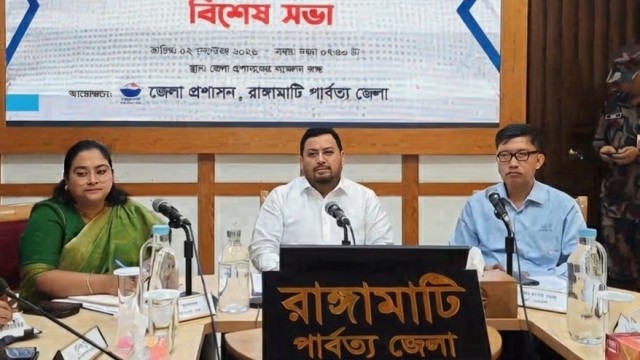
RANGAMATI, Sept 03 (V7N) — State Minister for Chittagong Hill Tracts Affairs Barrister Mir Helal Uddin has stressed the need for a long-term and coordinated approach to reduce armed activities and violence in the Chittagong Hill Tracts, saying security operations alone cannot provide a sustainable solution.
He said efforts to restore peace and stability in the hills must go hand in hand with education, social development, employment opportunities, tourism and infrastructure development.
“Sending the army, Rapid Action Battalion (RAB) or police and conducting operations cannot provide a sustainable solution. Where there is darkness, we have to bring light through education, social development and employment opportunities. The more light we create, the more the darkness will recede,” the state minister said.
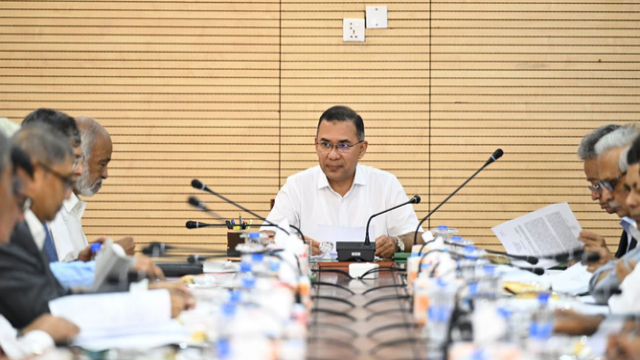
He made the remarks while speaking to journalists at a meeting at the conference room of the Rangamati Deputy Commissioner’s Office at around 10:30pm on Wednesday.
The meeting was organised to review and coordinate efforts concerning the district’s law and order situation, control of drugs and corruption, good governance, transparency and accountability, as well as development activities aimed at public welfare.
Earlier, from around 8:30pm, the state minister held discussions with political leaders, members of the Rangamati Hill District Council, officials of the district administration, intelligence agencies, law enforcement agencies and senior officials of various government departments.
‘Holistic approach’ to peace and development
Mir Helal said the government wants to address the longstanding challenges of the Chittagong Hill Tracts through a “holistic approach”.
He said legal measures were necessary, but they needed to be accompanied by initiatives in education, social development, tourism, employment and improvement of living standards.
“Change will not happen overnight. We are taking measures gradually. Arms and violence will decline over time. It is a process. Legal action will be part of that process, alongside education, social development, tourism and employment initiatives,” he said.
Regarding armed activities, the state minister said the tendency among people to become involved in separatist or violent activities would decrease if their living standards improved and they had greater opportunities to become economically self-reliant.
“We need to create opportunities for farmers to receive fair prices for their produce and for people to become self-reliant,” he said.
According to the minister, ensuring long-term economic and social development alongside law enforcement is essential to establishing lasting peace and stability in the hills.
Development must protect the environment
Mir Helal also stressed the importance of protecting the environment and nature in development plans for the Chittagong Hill Tracts.
He said the government would not approve development that damages the region’s natural beauty and environment.
“Development must be carried out in harmony with nature while preserving our natural beauty. Whether it is infrastructure development, tourism or any other construction, everything must be done without harming the environment,” he said.
He also emphasised the need to link the region’s tourism potential with employment opportunities and economic empowerment for local communities.
Focus on education in remote areas
The state minister said the meeting also discussed ways to improve the quality of education in Rangamati, particularly for students living in remote areas.
The expansion of e-learning facilities, accommodation for female students and improved transport facilities were among the issues discussed.
He said Rangamati’s recent Secondary School Certificate (SSC) examination results had not been satisfactory and that initiatives would be taken to introduce e-learning facilities in remote areas through internet connectivity so that students are not deprived of modern educational opportunities.
He described expanding access to education in remote hill areas as one of the key foundations for long-term social change.
Strengthening agriculture and local economy
Mir Helal also highlighted the need to strengthen agriculture and the local economy to improve the financial capacity of people living in the hills.
He said steps would be taken to ensure that farmers receive fair prices for their produce and that local communities have greater opportunities to become economically self-reliant.
He said expanding legitimate income and employment opportunities would help reduce the scope for people to become involved in crime and violent activities.
‘Zero tolerance’ against corruption
The state minister said the government had adopted a zero-tolerance policy towards corruption and that legal action would be taken wherever evidence of corruption was found.
“We have all declared zero tolerance against corruption. Wherever evidence of corruption is found, strict action will be taken,” he said.
At the same time, he said no one would be harassed through cases or allegations based merely on assumptions.
He said complaints would be investigated by the appropriate authorities and action would be taken through due legal and judicial processes.
Local issues discussed
The meeting also identified several local problems in Rangamati, including the need for water ambulances, traffic police and water-based fire-fighting services.
Mir Helal said necessary initiatives would be taken in coordination with the relevant administration and authorities, taking into consideration the district’s geographical characteristics and the needs of its people.
The meeting also discussed various government social programmes, including piloting of the Family Card programme, assistance for farmers, preparation of lists of imams, muezzins and religious institutions, and initiatives for economically disadvantaged and underprivileged people.
Call for coordinated efforts
Mir Helal said the government wanted to reduce the distance that had developed between the administration and the people in the past.
He stressed the importance of coordinated efforts involving the Hill District Council, district administration, political leaders, elected representatives, journalists and other stakeholders to promote development and peace in the hills.
Responding to a question about the continued suspension of land settlements in the hill areas and the suspension of loans in market fund areas, the state minister said the government had been elected by the people and would take necessary steps based on public demands after consulting all relevant stakeholders.
“We want to work in a coordinated manner and, InshaAllah, build this region into a developed, prosperous and harmonious area,” he said.
The state minister said extensive discussions had been held with relevant stakeholders on the overall situation in Rangamati and that local problems had been identified for priority-based action.
Rangamati Member of Parliament and former minister Dipen Dewan, Rangamati Hill District Council Chairman Dipan Talukdar Dipu, and officials from the district administration, law enforcement agencies, intelligence agencies and various government departments attended the meeting.
END/AMR/SMA/