


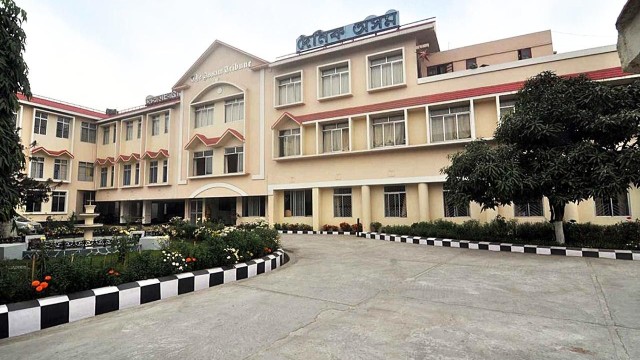
Guwahati, Jan 13 (V7N) — The well-known Assamese weekly newspaper Asom Bani has stopped publication amid an existential crisis faced by the Assam Tribune group of newspapers, a situation that worsened significantly after the Covid-19 pandemic. Although the weekly formally ceased publication in September 2025, the management did not issue any official statement clarifying its future, leaving readers and media observers uncertain about its fate.
Asom Bani, a Guwahati-based Assamese-language weekly launched on July 1, 1955, was once a mainstream publication for Assamese readers for decades. In its later years, it was merged with Dainik Asom, a leading Assamese daily of the same media house, and continued as a Friday supplement. The weekly last appeared on newsstands on September 12, 2025.
Founded by legendary Assamese entrepreneur Radha Govinda Baruah, Asom Bani played a significant role in documenting major socio-political developments in Assam. Its reporting spanned historic movements such as the Assamese medium movement, the Assam anti-influx agitation, the rise of insurgency, periods of social unrest, and the evolution of regional politics. Over the years, the weekly was edited by several eminent journalist-authors, including Satish Chandra Kakati, Tilak Hazarika, Phani Talukdar, Nirod Chowdhury, Homen Bargohain and Chandraprasad Shaikia. Dilip Chandan, its last editor, served the publication for nearly three decades.
The pandemic dealt a severe blow to the circulation of all newspapers under the Assam Tribune group, leading to a sharp decline in advertising revenue. This financial strain resulted in irregular salary payments and mounting dues to both current and retired employees. The employees’ union publicly raised concerns over unpaid salaries, retirement benefits, and alleged non-payment of substantial advertisement bills by the state information and public relations directorate.
During this period, rumours surfaced regarding the possible sale of the Assam Tribune group to another city-based television network. The management strongly denied these claims, describing them as baseless, and reiterated its commitment to editorial independence and journalistic integrity. Despite these assurances, the group eventually handed over Dainik Asom, now over six decades old, to a different media group owned by entrepreneur Kishor Borah, who operates the Assamese satellite news channel ND24. The transfer was made public on September 17, 2025.
The new management continued publishing Dainik Asom but did not retain Asom Bani as a standalone or supplementary publication. Following the transition, more than 70 employees lost their jobs on September 18, many of whom had been working on extended contractual terms. Although assurances were given that all legal dues would be settled within weeks, the payments reportedly did not materialise. The affected employees have since approached the labour court, claiming unpaid dues amounting to approximately six crore rupees.
Ironically, the Assam Tribune group was the first media institution in India to implement the recommendations of the Majithia Wage Board in 2012. Media observers now view the current situation as a stark contrast to its earlier reputation for fair labour practices and credible journalism.
Founded in 1939, The Assam Tribune remains the highest-circulated English daily in northeast India. However, critics argue that in recent years its editorial neutrality and professional standards have been questioned, particularly during politically sensitive periods. Observers note that while the pandemic exacerbated financial difficulties, internal discord and management inaction also contributed to the present crisis.
The closure of Asom Bani is widely seen as a significant loss to Assamese journalism, marking the end of an era for a publication that once played a vital role in shaping public discourse in the region.
END/NT/SMA/














Comment: