


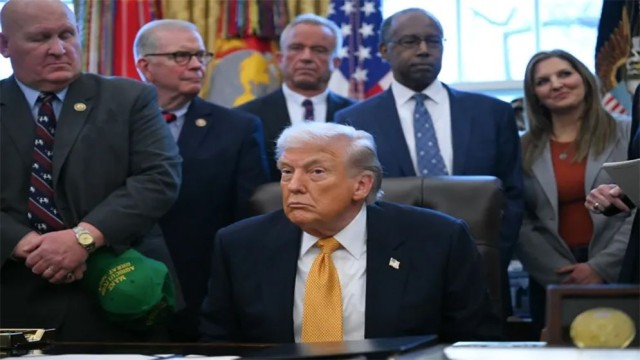
WASHINGTON, United States, Feb 19, (V7N) — US President Donald Trump has gathered a diverse group of international leaders for the inaugural meeting of his new initiative, the "Board of Peace." The meeting, which will focus on the ongoing situation in Gaza, marks the next phase in Trump's ambitious plan to address the crisis in the region, with an eye on global security challenges beyond Gaza as well.
Held in Washington, the meeting brings together around two dozen leaders, most notably those from countries with authoritarian-leaning governments. These include Hungarian Prime Minister Viktor Orban and Argentina's President Javier Milei, while major Western democracies, such as France and Canada, are notably absent. The initiative has garnered mixed reactions, with some praising the effort for its boldness and others questioning its coherence.
The "Board of Peace" was formed after the US, Qatar, and Egypt brokered a ceasefire in October 2024, halting two years of conflict in Gaza. The new phase of the plan now targets disarming Hamas, the Palestinian militant group whose October 2023 attack on Israel sparked the conflict. At Thursday's meeting, Trump will announce over $5 billion in pledges for Gaza's reconstruction, a place where much of the infrastructure lies in ruins.
In line with this effort, Trump has suggested the development of resorts in Gaza, a notion that has raised eyebrows, with critics questioning the feasibility of such plans amid the region's devastation.
One key player in the meeting is Indonesia, the world’s largest Muslim-majority country, which has indicated it is willing to send up to 8,000 troops as part of an International Stabilization Force to maintain security in Gaza. Indonesian President Prabowo Subianto is attending the meeting following his participation in the launch event at the World Economic Forum in Davos.
The "Board of Peace" also plans to establish a technocratic committee to handle Gaza's day-to-day governance. This new body will be led by Ali Shaath, a former official, in an attempt to stabilize the region under more neutral control.
While the focus remains on Gaza, the "Board of Peace" is being positioned as a tool for addressing other global hotspots. US officials have suggested that the board could expand its scope, though critics have raised concerns about the lack of a clear structure and intellectual rigor behind the initiative.
Bruce Jones, a senior fellow at the Brookings Institution, critiqued the project as a "confused mix of ambition and narcissism," lacking in the coherent strategies often needed to manage complex international issues.
The meeting also highlights the ideological divide that defines Trump’s foreign policy approach. Leaders like Orban and Milei, known for their right-wing stances, align with Trump’s vision, while many traditional US allies, including France, Canada, and Brazil, have expressed reservations. Brazilian President Luiz Inacio Lula da Silva declined to join, calling for a broader international approach that includes a seat for Palestine, dismissing the board as "a new UN where only Trump is the owner."
In addition to its focus on Gaza, the meeting will also discuss the long-term role of the "Board of Peace" in global diplomacy. While Trump’s supporters view it as a bold move to create a new platform for peace, detractors see it as an extension of his personal agenda and an attempt to sidestep traditional diplomatic channels like the United Nations.
The outcome of the "Board of Peace" initiative will be closely watched as it progresses through its first phase and into its broader global ambitions.
END/WD/RH/














Comment: