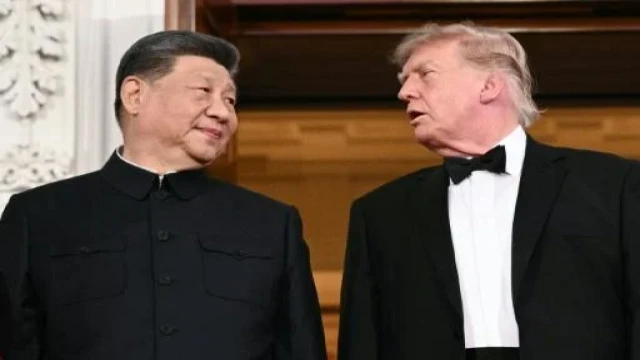
Sept 25 (V7N) - US President Donald Trump treated Chinese leader Xi Jinping to pomp and pageantry in Washington DC, greeting him on the runway, offering a rare presidential helicopter tour, and gifting him a bald eagle statue. Despite hailing a "great friendship," analysts noted the high-profile spectacle masked a lack of major diplomatic breakthroughs, with less than two hours spent in direct talks. Beyond general consensus and minor agreements—such as sending 100,000 young Americans to China and loaning two pandas to an Atlanta zoo—the summit served primarily to keep major power competition within tolerable bounds.
Artificial intelligence emerged as a major point of friction, with the two leaders outlining divergent approaches to the technology. Trump advocated for light regulation to maintain rapid development—referring to the technology as "super intelligence"—while Xi insisted that AI must "always be under human control" and serve the public good. Experts noted that deep-seated strategic suspicion and intensifying technological competition make any meaningful bilateral agreement on governing AI unlikely in the near term.
On economic matters, both sides agreed to a two-month extension of their fragile trade truce, which was originally set to expire in November. While this detente keeps tariffs lower for the time being, it leaves fundamental issues—including Beijing's rare-earth export controls, US tech restrictions, and Chinese purchases of American farm produce—unresolved. Analysts view the brief extension as a temporary buffer to stabilize relations rather than a lasting economic resolution.
The ongoing crisis in the Middle East was another point of contention during the summit. Trump repeatedly urged Beijing to help de-escalate US conflicts in the region and assist in reopening the Strait of Hormuz to international shipping. However, Chinese officials rebuffed these calls, with Xi advising Trump to seek a direct negotiated settlement with Tehran instead. Foreign policy experts remain skeptical that China will act as a major power broker to pull the US out of regional conflict.
Cross-strait relations remained a highly sensitive topic, as Xi urged Washington to exercise "prudence" on Taiwan and explicitly oppose its independence. Beijing’s firmer stance comes while a $14 billion US military sales package for Taiwan remains on hold and under review. Though Trump previously hinted that arms sales could serve as leverage in negotiations, foreign policy analysts expect the fundamental US commitment to Taiwan's defense to remain intact.
Ultimately, the meeting highlighted how both superpowers are seeking to manage their intensifying rivalry without risking direct military conflict. By invoking the "Thucydides Trap," Xi warned against the inevitability of confrontation between an established power and a rising one. While ceremonial diplomacy provided temporary calm, deep structural divisions across technology, trade, and regional security ensure that competition between the US and China will remain tense.
end/wd/rh/