


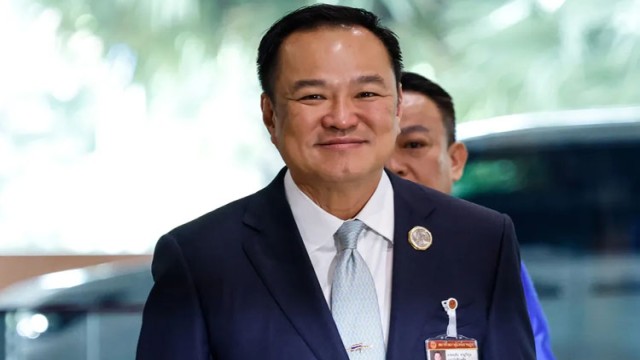
Bangkok, Feb 5 (V7N) — Thai Prime Minister Anutin Charnvirakul is widely expected to remain in office after this weekend’s general election, regardless of the final vote outcome, as post-election coalition negotiations are likely to return him to power, analysts say.
Anutin, a 59-year-old conservative and heir to a major construction fortune, became prime minister in September after his predecessor Paetongtarn Shinawatra was removed by a court ruling. Although his Bhumjaithai party placed third in the last election, he secured the premiership with parliamentary backing, including support from the reformist People’s Party, Thailand’s largest political grouping.
“I came into office with a majority in the parliament,” Anutin told AFP during campaigning in Bangkok. “So it is clearly democratic.”
Opinion polls suggest the People’s Party will again win the most seats, ahead of Bhumjaithai, but no party is expected to secure an outright majority. Political observers believe Anutin is well placed to emerge as prime minister once more through coalition bargaining, with the most likely partner being Pheu Thai, the long-dominant party of the Shinawatra family.
Despite his personal wealth, Anutin cultivates a populist image, frequently appearing on social media enjoying street food, cooking at roadside stalls, or playing 1980s Thai pop music on the saxophone and piano.
A member of a powerful political and business dynasty, Anutin’s family controls Sino-Thai Engineering, a firm that has won major government contracts, including projects for Bangkok’s main airport and the parliament complex. His father previously served as acting prime minister during a 2008 political crisis and later as interior minister.
Anutin’s political career has long intersected with that of the Shinawatras. Educated in the United States as an industrial engineer, he entered politics through former prime minister Thaksin Shinawatra’s Thai Rak Thai party before being banned from politics for five years after its dissolution in 2007. During that period, he took up flying and became known for using private aircraft to deliver donated organs for transplant operations.
Returning as leader of Bhumjaithai, Anutin proved a flexible political operator, joining multiple governing coalitions and serving as deputy prime minister under three leaders, including Paetongtarn. As health minister during the pandemic, he oversaw Thailand’s Covid-19 response and later gained international attention in 2022 by pushing through the decriminalisation of cannabis to boost the economy.
The Shinawatra family’s political influence has weakened in recent years. Thaksin is now imprisoned on corruption charges, while Paetongtarn was removed as prime minister by the constitutional court over her handling of a sensitive border dispute with Cambodia.
Anutin withdrew Bhumjaithai from a coalition with Pheu Thai in June after a leaked phone call in which Paetongtarn referred to Cambodia’s former leader Hun Sen as “uncle” and described a Thai military commander as her “opponent,” triggering a public backlash. Subsequent clashes along the Thai-Cambodian border in July and December killed scores on both sides and displaced more than one million people.
Analysts say the renewed nationalism sparked by the conflict has boosted Bhumjaithai’s appeal, particularly among voters favoring a strong military stance and the preservation of Thailand’s strict royal insult laws.
“The conflict reshaped voter priorities around the role of the military and safeguarding Thailand’s territorial sovereignty,” said political scientist Napon Jatusripitak. “The only credible party able to take a nationalist and hawkish position is Bhumjaithai.”
Three months after taking office, and shortly before a ceasefire was reached in late December, Anutin dissolved parliament and called the snap election.
Speaking in Bangkok’s Chinatown during campaigning, he stressed that while peace was preferable, Thailand must stand firm. “Nobody wants fighting, nobody wants conflict,” he said. “But we have to defend our integrity and sovereignty.”
END/WD/RH








Comment: