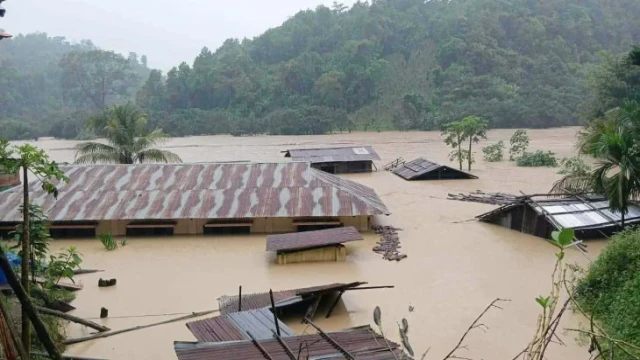
Rangamati, Jul 19 (V7N)- Continuous heavy rainfall, flash floods triggered by upstream hill runoff, and recent flooding have caused an estimated Tk 3.94 crore in losses to the fisheries sector in Bangladesh's southeastern hill district of Rangamati.
According to a recent damage assessment report signed by Rangamati District Fisheries Officer Mohammad Mizanur Rahman, a total of 223 fish farms across 29 unions in 10 upazilas have been affected by the floods.
The report states that 97.67 hectares of ponds, creeks and other water bodies were inundated, resulting in the loss of 89 metric tonnes of finfish and approximately 22 lakh fish fry, either washed away or destroyed.
The report estimates the market value of the lost fish at Tk 1.88 crore, while the loss of fish fry amounts to Tk 1.01 crore. Damage to fisheries infrastructure has been assessed at Tk 1.05 crore, bringing the total estimated loss to Tk 3.94 crore.
Baghaichhari Worst Affected
Among the district's upazilas, Baghaichhari suffered the highest level of damage. Floodwaters affected 81 fish farms across 10 unions, inundating 43.87 hectares of water bodies.
The flooding washed away 62.45 metric tonnes of fish and approximately 16.27 lakh fish fry, causing losses estimated at Tk 2.55 crore.
Damage in other upazilas was estimated as follows:
Jurachhari: Tk 66.42 lakh (24 farms)
Kaukhali: Tk 21.50 lakh (30 farms)
Rajasthali: Tk 15.86 lakh (57 farms)
Kaptai: Tk 11.80 lakh (6 farms)
Barkal: Tk 8.50 lakh (15 farms)
Langadu: Tk 6.40 lakh (1 farm)
Bilaichhari: Tk 4.30 lakh (1 farm)
Naniarchar: Tk 2.55 lakh (3 farms)
Rangamati Sadar: Nearly Tk 1.80 lakh (6 farms)
Government Preparing Rehabilitation Plan
District Fisheries Officer Mohammad Mizanur Rahman said prolonged rainfall and flash floods caused ponds, creeks and other water bodies across the district to overflow, leading to the loss of a significant quantity of fish and fish fry.
"The preliminary damage assessment has already been submitted to the district administration. Once government assistance is allocated, initiatives will be taken to rehabilitate the affected fish farmers," he said.
He added that the Ministry of Fisheries and Livestock has recently instructed local authorities to prepare a comprehensive and accurate assessment of the losses. In response, fisheries officials at all levels have begun field visits, collecting information directly from affected fish farmers throughout the district.
The completed assessment will be submitted to the ministry to facilitate rehabilitation programmes and financial assistance for the affected farmers. He noted that the overall damage estimate may increase, as information from several remote areas is still being collected.
Livelihoods Under Threat
People involved in the fisheries sector said many marginal households in the Chittagong Hill Tracts depend on small-scale fish farming as their primary source of income. The loss of fish stocks and fish fry has left many families facing severe financial hardship and struggling to resume production.
They urged the government to provide free or subsidised fish fry, financial assistance to repair damaged ponds and embankments, low-interest loans, fish feed and other production inputs, as well as technical support to help farmers recover quickly.
Experts warned that climate change is increasing the frequency of extreme weather events and flash floods in the hill districts. They stressed the need for long-term investment in flood-resilient fisheries infrastructure, stronger protection for fish ponds and water bodies, improved early warning systems, and expanded post-disaster rehabilitation programmes.
Such measures, they said, would help safeguard the livelihoods of marginal fish farmers while reducing the impact of future disasters on fish production and the local economy.