
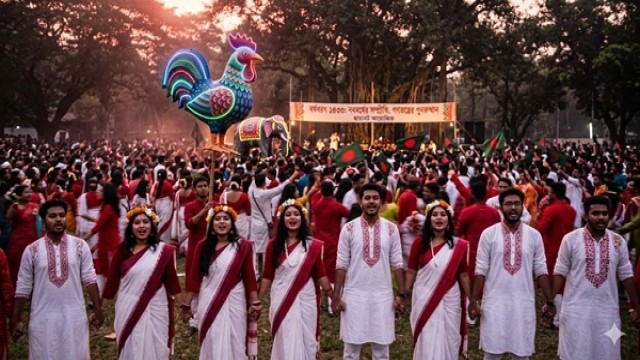
DHAKA, April 14, 2026 — Under a shimmering crimson sun, the nation awoke today to the soulful echoes of “Eso He Baishakh,” marking the dawn of Bangla Noboborsho 1433. From the sprawling urban landscape of Dhaka to the serene riverine borders of Barishal and Rajshahi, millions of Bangladeshis have converged to shed the "sorrows and fatigue" of the outgoing year. This year’s celebration holds a profound significance, operating under the central theme: “Harmony of the New Year, Revival of Democracy,” reflecting a collective national aspiration for political stability and cultural preservation.
The historic Ramna Batamul served as the spiritual epicenter of the morning. Organized by Chhayanaut, the event began at the crack of dawn with classical ragas and iconic Rabindra Sangeet, creating a tranquil atmosphere of peace and humanity. Thousands gathered in traditional red-and-white attire, defying the intense Chaitra heat to witness a tradition that has stood as a bulwark of Bengali secular identity for decades. The rhythmic beats of the dhak (traditional drum) signaled not just a change in the calendar, but a renewal of the "Bengali soul."
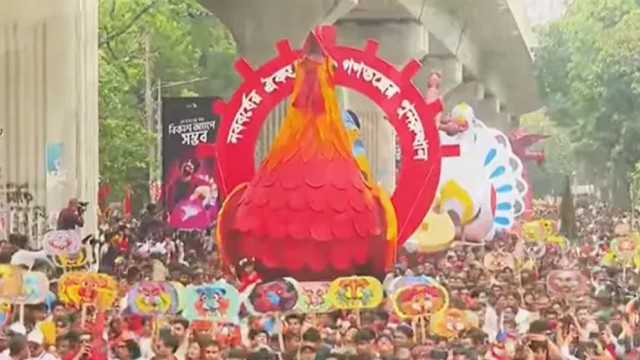
In the capital’s academic heart, the Faculty of Fine Arts at Dhaka University brought out the world-renowned Mangal Shobhajatra (this year titled 'Baishakhi Shobhajatra'). The procession was a kaleidoscope of heritage, featuring five massive motifs: the rooster, the dotara, the pigeon, the elephant, and the horse. These symbols—representing strength, creativity, peace, dignity, and movement—were paraded alongside 200 students carrying the national flag. The streets transformed into a canvas of folk art, reinforcing the message that the nation's democratic future is inextricably linked to its cultural roots.
Political leadership echoed this sentiment of renewal. President Mohammed Shahabuddin and Prime Minister Tarique Rahman issued separate messages to the nation. The President described the day as a "universal festival," calling for a commitment to national unity. Prime Minister Tarique Rahman, meanwhile, highlighted the deep-seated connection between the New Year and the agricultural economy, noting that the Halkhata (traditional accounting) remains a unique symbol of rural heritage and the "determination to move forward" despite global economic shifts.
The celebrations were equally vibrant in the divisional hubs. In Khulna, a colorful procession paraded from the Railway Station to Shaheed Hadis Park. Acting Divisional Commissioner Mohammad Nazmul Haque addressed a massive gathering, noting that Pahela Baishakh is the ultimate "non-communal" festival that brings together people of all faiths. Meanwhile, in Bagerhat, the festivities took on a democratic fervor, with Deputy Commissioner Golam Md. Baten leading a rally that moved through the historic Khanjahan Ali area, followed by a separate rally organized by the local BNP to mark the occasion.
Rajshahi, the city of silk, saw its streets come alive with the theme ‘Noboborsher Oikyatan, Gonotantrer Punruthhan’. Land Minister Mizanur Rahman Minu joined the procession at the Central Park, where he inaugurated a two-day Baishakhi fair. The presence of local artisans and the release of symbolic balloons into the northern sky served as a powerful reminder of the region's resilience. The festivities spread to the Paba upazila, where folk fairs and essay competitions for students showcased a "bottom-up" celebration of the new year.
Down south in Barishal, the Udichi Shilpi Gosthi and Barishal Natak turned the BM School grounds into a theater of folk heritage. The program honored brave freedom fighters, blending the spirit of the 1971 Liberation War with the joy of 1433. The three-day Baishakhi fair in Barishal has already become a major draw, featuring traditional games like Ha-du-du and Lathi Khela. Participants expressed a localized hope: to leave behind the "physical suffering" of the recent heatwaves and build a "better Bangladesh" through collective effort.
In Narail, the legacy of the legendary artist SM Sultan was palpable. The district administration began the day at the Sultan Mancha, concluding at the Shilpakala Academy. Deputy Commissioner Dr. Mohammad Abdul Salam emphasized that educational institutions, particularly the Sultan Fine Arts College, are vital in ensuring that the younger generation remains rooted in their "distinct cultural identity" amidst a rapidly modernizing world. Traditional Boli Khela (wrestling) matches also drew massive crowds, echoing the century-old tradition of Jabbarer Bolikhela in Chattogram.
The commercial sector also embraced the transition. In rural marketplaces and the bustling alleys of Old Dhaka, the tradition of Halkhata saw shopkeepers opening new ledgers. Sweetmeats were distributed to customers as debts were settled, symbolizing a "clean slate" for the economy. This economic ritual, paired with the government's free entry to museums and archaeological sites like the Shatgombuj Mosque, ensured that the celebrations reached every stratum of society, regardless of financial standing.
Security and public welfare remained a top priority. The Dhaka Metropolitan Police (DMP) and RAB deployed thousands of personnel across the capital to ensure a "peaceful and festive" environment. Strategic locations like Suhrawardy Udyan and Ramna Park were equipped with emergency medical facilities, mobile toilets, and safe drinking water. In an act of social inclusion, special traditional meals were served in prisons, hospitals, and government orphanages (Shishu Poribars), ensuring that those in confinement or hardship were not left out of the national joy.
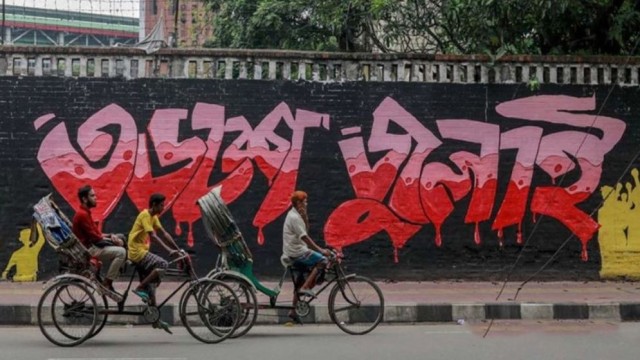
The cultural resistance against "social fascism" was a recurring motif this year. Udichi hosted a day-long event at Topkhana Road with the fierce theme: ‘Let social fascism be destroyed in the fierce spirit of Baishakh.’ This political undertone across various cultural platforms suggests that Pahela Baishakh 1433 is viewed not just as a holiday, but as a "rejuvenation of the democratic spirit," where the vibrancy of the Bengali culture serves as a shield against any form of oppression.
As the day transitions into the evening of April 14, the festivities show no sign of slowing down. With puppet shows at the Military Museum and folk fairs continuing in every upazila, the message of Noboborsho 1433 is clear: Bangladesh is moving forward with a "renewed energy and optimism." In a world fraught with geopolitical and economic uncertainty, the "Harmony of the New Year" stands as a testament to a nation that finds its greatest strength in its shared history, its agricultural roots, and its unwavering cultural identity.
Shuvo Noboborsho!
END/RH/







Comment: