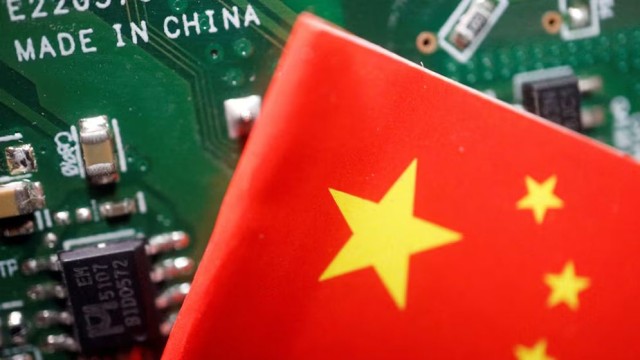
Shenzhen, Dec 18 (V7N) — China has launched an ambitious initiative to develop indigenous artificial intelligence (AI) chip technology, aiming to compete directly with Western powers in one of the world’s most strategic industries. The project has been dubbed China’s “Manhattan Project” for semiconductors.
According to a report by British news agency Reuters, Chinese scientists working inside a high-security laboratory in Shenzhen have successfully built a prototype chip-making machine—a development Washington has long sought to prevent through export controls and sanctions.
The prototype, completed in early 2025, is currently undergoing testing. The massive machine reportedly occupies almost the entire factory floor and is being developed with the involvement of former senior engineers from ASML, the Dutch technology giant that dominates the global market for advanced chip-manufacturing equipment.
ASML is the world’s sole supplier of extreme ultraviolet (EUV) lithography machines, which are essential for producing the most advanced semiconductor chips. These machines use ultra-fine ultraviolet light to etch microscopic circuits, enabling the production of smaller, faster, and more powerful chips.
Previously, ASML CEO Christophe Fouquet stated that it would take “many years” for China to replicate such advanced technology. However, Reuters’ report suggests that China may be far ahead of analysts’ expectations, potentially accelerating its breakthrough in semiconductor independence.
If confirmed, this development could significantly undermine Western technological dominance, particularly that of the United States and its allies. China has already demonstrated its growing AI capabilities with the development of advanced AI models such as DeepSeek, which reportedly rivals US-based platforms like OpenAI at a fraction of the cost.
Analysts note that if China succeeds in independently manufacturing advanced semiconductor chips, it could flood global markets with lower-priced AI hardware, reshaping the competitive landscape of the technology sector.
EUV lithography machines remain at the center of the technological cold war between China and the West. Control over this technology is widely seen as a key determinant of future economic power, military capability, and AI supremacy.
While Beijing has not officially commented on the report, the emergence of such a prototype signals a potentially historic shift in the global semiconductor race.
END/SMA/AJ