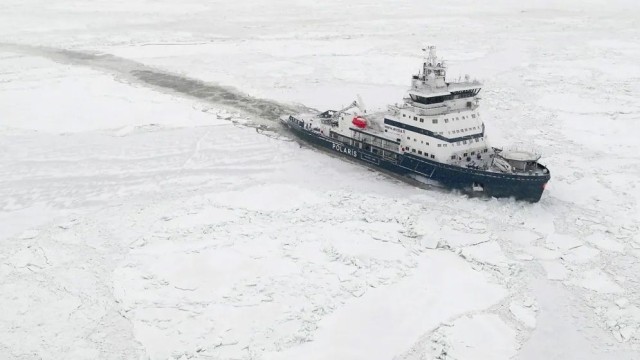
Washington Jan 20 (V7N) — Amid repeated assertions by US President Donald Trump regarding ownership of Greenland, the United States has ordered icebreaker ships from Finland as part of its broader strategy to strengthen its presence in the Arctic region.
International media outlet BCB confirmed the development in a recent report, noting that Finland—widely regarded as the world’s leading icebreaker shipbuilder—has been strategically engaged by Washington.
Currently, testing is underway at the Aker Arctic Technology Laboratory in Helsinki, where a scaled model of a next-generation icebreaker is being evaluated in a 70-metre-long ice tank. The model demonstrates its ability to move forward by bending and breaking thick ice sheets, a critical feature for Arctic navigation.
Engineer Riika Matala said ensuring sufficient engine power and performance efficiency is essential for the vessel. Meanwhile, Mika Hovilainen, CEO of Aker Arctic, emphasized that the ship’s hull design is equally crucial.
“The hull must bend downward and break the ice—it should not cut or tear through it,” he explained.
Finland holds a dominant position in the global icebreaker industry. About 80 percent of the world’s icebreakers are designed by Finnish companies, while 60 percent are built in Finnish shipyards.
Maunu Vissari, CEO of Finland’s state-owned company Arctia, said Finland is unique in that all of its ports can freeze during winter, while 97 percent of its imports arrive through maritime routes. Icebreakers are therefore vital to keeping shipping lanes open during extreme weather conditions.
Given Finland’s expertise, President Trump announced in October last year that the United States would order four icebreakers from Finland for the US Coast Guard. An additional seven vessels will be built in the United States, using Finnish design and technology. These ships are officially designated as “Arctic Security Cutters.”
“We are buying the best icebreakers in the world, and Finland is famous for building them,” Trump said at the time.
Although US law generally requires naval and coast guard vessels to be domestically built, the administration relaxed these rules, citing national security concerns, including increased military activity and economic influence by Russia and China in the Arctic.
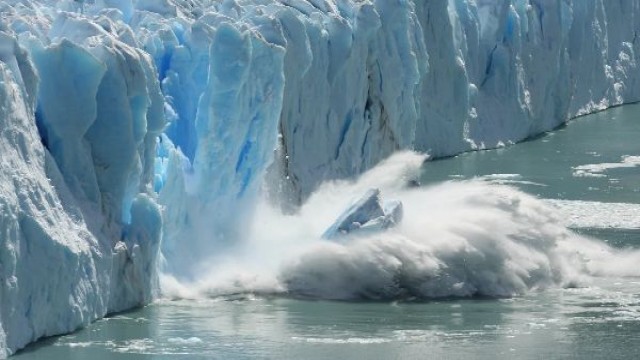
Climate change has made the Arctic Ocean increasingly navigable, opening up new trade routes between Asia and Europe—either via Russia’s northern coast or around Alaska, Canada, and Greenland. The melting ice has also improved access to oil and gas reserves beneath the Arctic seabed.
Peter Rybsky, a Helsinki-based Arctic expert and retired US naval officer, noted that traffic in the region has reached unprecedented levels.
“There is growing oil and gas activity in Russia, and new transshipment routes between Europe and Asia are rapidly developing,” he said.
END/SMA/AJ