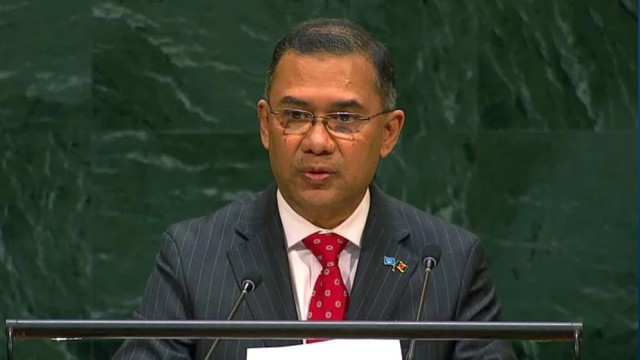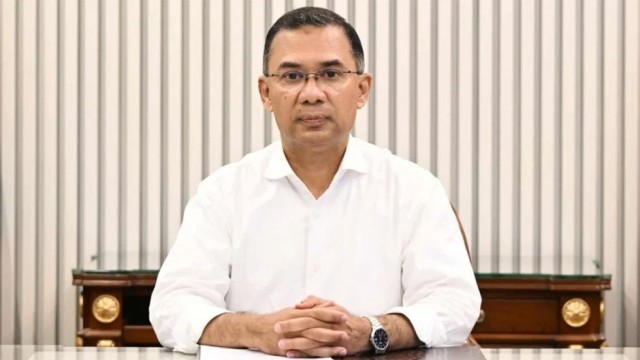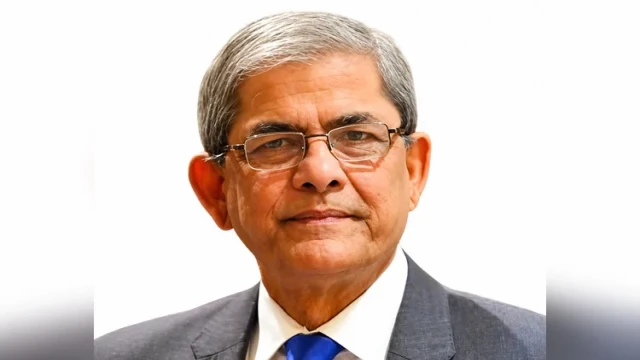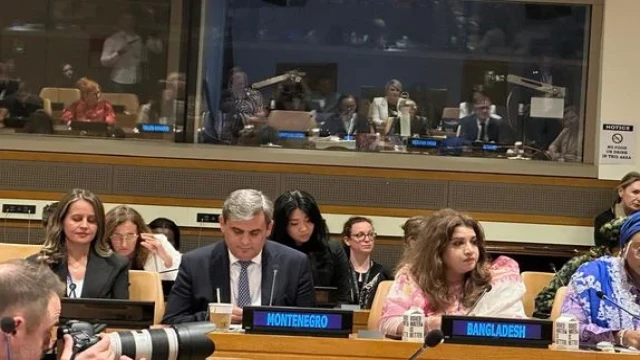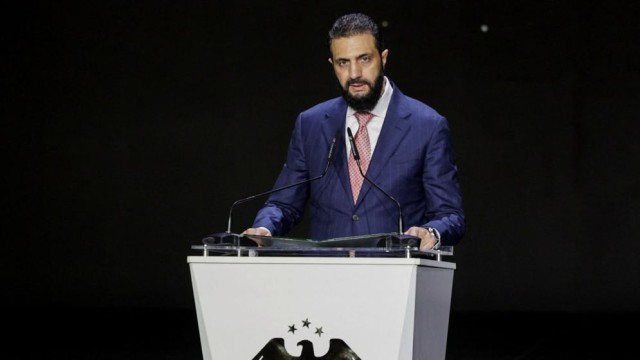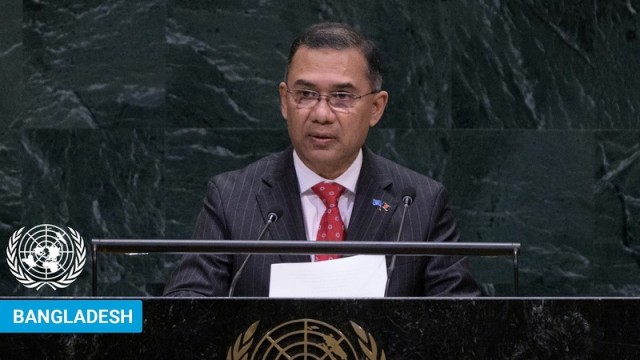
NEW YORK, Sept 26 (V7N) — Bangladesh Prime Minister Tarique Rahman used his first address to the 81st session of the United Nations General Assembly to present his government’s vision for a transformed Bangladesh while calling for diplomacy, dialogue and humanity to take precedence over military force in addressing global conflicts.
In his General Debate speech at UN Headquarters in New York on Thursday, Rahman highlighted Bangladesh’s priorities on global peace and security, democratic and economic transformation, the Rohingya crisis, climate change, migration, education, women and youth empowerment, and equitable access to emerging technologies.
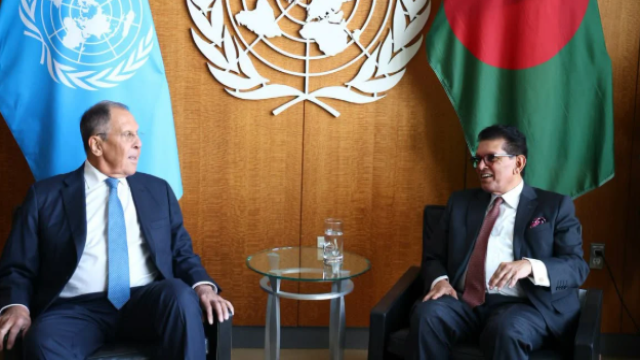
His address came amid an intensive series of diplomatic engagements on the sidelines of the UNGA, including meetings with UN Secretary-General António Guterres, Pakistani Prime Minister Muhammad Shehbaz Sharif and Iranian President Masoud Pezeshkian, as well as discussions surrounding Bangladesh’s aviation sector and a new Boeing aircraft procurement agreement.
Diplomacy over weapons
Rahman said conflicts should be resolved through dialogue, diplomatic processes and mutual cooperation, arguing that equality, fairness, mutual interests, respect and dignity should underpin relations among states.
Bangladesh, he said, wants a peaceful and humane world in which reason, debate, diplomacy, education and humanity—not nuclear weapons—serve as instruments of change. He also reaffirmed Bangladesh’s support for multilateralism, disarmament, arms control and the UN’s role in promoting international peace and security.
The remarks were delivered under the 81st UNGA theme, “Restoring Trust, Managing Transformation: A United Nations that Delivers for All,” which Rahman described as particularly relevant to the present global situation.
A 31-point roadmap for Bangladesh
A major part of the speech focused on Bangladesh’s domestic transformation. Rahman said a state cannot become strong by keeping its citizens powerless and outlined the government’s objective of establishing a prosperous, self-reliant and welfare-oriented democratic state through political and economic empowerment.
He referred to the 31-point programme presented to voters ahead of the Feb. 12 national election and said the government was implementing the programme.
According to Rahman, 73 percent of the programme’s activities have a direct alignment with the UN Sustainable Development Goals’ principle of “leaving no one behind,” while another 27 percent have an indirect alignment.
He highlighted initiatives including Family Cards, Farmers Cards, Sports Cards and e-Health Cards, saying a future Universal Card could integrate these services. The Family Card, issued in the name of the female head of a household, was also presented as a mechanism for strengthening women’s economic empowerment.
Rohingya crisis remains a major priority
The prolonged Rohingya crisis featured prominently in Bangladesh’s diplomatic agenda at the UN.
Rahman called for stronger and more effective international support to achieve a durable solution to the crisis and stressed that life-saving humanitarian assistance should continue until the displaced Rohingyas can return safely to Myanmar.
Bangladesh is hosting more than 1.2 million Rohingyas, and Rahman said their safe return to their homeland remains the only sustainable solution. He also called for international action to protect their rights, dignity and welfare.
On the sidelines of the General Assembly, Bangladesh also organised a high-level Rohingya event, where the government sought stronger international backing for safe, voluntary and dignified repatriation and accountability for crimes committed against the displaced population.
Climate justice and the threat of rising seas
Climate change was another central theme of Bangladesh’s UNGA diplomacy.
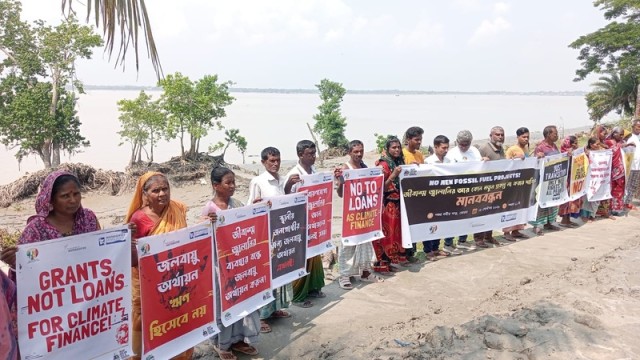
Rahman warned that rising sea levels pose an existential threat to coastal and island countries and called for stronger international cooperation, predictable climate financing, technology access and adaptation support.
At a high-level UN meeting on the existential threats posed by sea-level rise, he called for faster and more equitable reductions in global carbon emissions, accessible financing for vulnerable countries, greater access to climate-smart technologies and stronger international cooperation to address climate-induced displacement, loss and damage.
In a separate climate-related address, Rahman said Bangladesh contributes less than 0.5 percent of global greenhouse-gas emissions while remaining highly vulnerable to climate impacts. He also highlighted Bangladesh’s plans for tree plantation, river and canal dredging, renewable energy and other climate-related measures.
Warning against a new AI divide
Technology and artificial intelligence also featured in Rahman’s UNGA message.
He warned that today’s digital divide must not become tomorrow’s AI divide. Developing countries, he said, need greater access to technology transfer, skills development and affordable modern technologies.
The government also sees a need for an effective international framework to ensure that the rapid expansion of artificial intelligence and social media benefits people around the world rather than deepening existing inequalities.
Education, women and youth
Rahman placed education and human-resource development among the government’s domestic priorities, outlining a plan to gradually raise education spending to 5 percent of GDP over the next five years.
He also highlighted technical and practical education as part of an effort to create a more employment-oriented education system.
Women’s education, employment and entrepreneurship were presented as additional priorities, including expanded financial support for women entrepreneurs in small and medium-sized enterprises and free education for women through the undergraduate level.
Meeting with Pakistan’s Shehbaz Sharif
On the sidelines of the UNGA, Rahman met Pakistani Prime Minister Muhammad Shehbaz Sharif at the UN Secretariat Building.
The two leaders discussed bilateral relations, regional and international developments and areas of mutual interest. They stressed the importance of advancing Bangladesh-Pakistan relations through mutual respect, understanding and cooperation.
The discussions also covered the situation in the Middle East and Pakistan’s efforts toward a peaceful resolution of the conflict. Bangladesh expressed support for efforts aimed at promoting peace.
Iran meeting: Middle East conflict, workers and Strait of Hormuz
Rahman also held talks with Iranian President Masoud Pezeshkian on the sidelines of the UNGA on Sept. 23.
The meeting focused on the impact of the Middle East conflict on Bangladesh, particularly the safety of Bangladeshi expatriate workers, remittances, shipping and energy security.
Bangladesh also sought Iran’s cooperation in facilitating the safe movement of Bangladeshi vessels and containers affected by disruptions around the Strait of Hormuz. Dhaka called for an early resolution of the conflict through diplomacy and stressed that prolonged regional instability could have serious consequences for Bangladesh’s energy security and overseas workforce.
The meeting therefore should be described as a diplomatic discussion, rather than an Iran-Bangladesh agreement or treaty.
Boeing agreement expands aviation plans
During the prime minister’s New York visit, Biman Bangladesh Airlines signed an agreement to purchase 11 additional Boeing aircraft.
Prime Minister’s Adviser Mahdi Amin said the procurement was linked to plans to expand Bangladesh’s aviation sector and open new international routes. Boeing representatives later paid a courtesy call on Rahman.
The United States also welcomed the planned purchase. According to BSS, the additional 11 aircraft would be in addition to 14 aircraft covered by an earlier $3.7 billion Boeing agreement signed in April, bringing the planned Boeing acquisition to 25 aircraft. Details of the price, financing arrangements, aircraft models and delivery schedule for the additional 11 aircraft had not yet been publicly disclosed.
The Boeing development added an important economic and commercial dimension to Bangladesh’s UNGA diplomacy, alongside discussions on trade, investment, technology and international connectivity.
Meeting with UN Secretary-General António Guterres
Rahman met UN Secretary-General António Guterres at the UN Secretariat Building on Thursday.
The two discussed Bangladesh-UN cooperation, global and regional developments, climate change and the Rohingya crisis. Rahman stressed the importance of UN support for Bangladesh’s priorities and reaffirmed the country’s commitment to multilateralism, international cooperation, peace and sustainable development.
Guterres emphasised the importance of further strengthening the longstanding cooperation between Bangladesh and the United Nations. Both sides expressed their commitment to continued cooperation in addressing common global challenges.
A broader diplomatic agenda
Rahman’s UNGA programme extended beyond the General Debate. His engagements included meetings with UN officials, foreign leaders, humanitarian organisations and international development partners.
On the Rohingya issue, Bangladesh sought stronger international support for safe and dignified repatriation. On the economic front, discussions covered trade, investment, skilled manpower, technology and international cooperation.
The prime minister also met Croatian Prime Minister Andrej Plenkovic, with the two sides discussing trade, investment, skilled manpower, education, technology and cooperation in multilateral forums.
Bangladesh’s message from New York
Taken together, Rahman’s UNGA address and his diplomatic engagements presented a broad outline of Bangladesh’s priorities: diplomacy instead of confrontation, international support for the Rohingya crisis, climate justice for vulnerable countries, wider access to technology and AI, greater economic and political empowerment at home, and stronger bilateral and multilateral cooperation abroad.
At the centre of the message was Bangladesh’s stated ambition to build a country where young people can pursue their aspirations, women can participate more fully in economic and social life, and children can develop their potential.
Rahman concluded his national vision around the slogans “Bangladesh First” and “Bangladesh for All,” while reaffirming Bangladesh’s support for UN principles and international efforts to promote global peace.
END/SMA/AJ/