


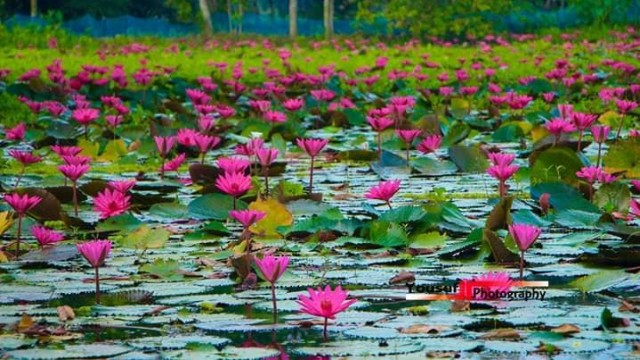
Sylhet, Jan 26 (V7N) — The renowned red water lily wetland at Dibir Haor in Jaintapur upazila of Sylhet is facing a serious threat as the unchecked spread of water hyacinth endangers its natural beauty and ecological balance, according to environmental activists and heritage conservationists.
The wetland, located in a border-adjacent area of Jaintapur, has in recent years emerged as a popular seasonal tourist destination, attracting visitors from across the country during the winter months. However, environmental groups fear that without urgent intervention, the aggressive invasion of water hyacinth could soon degrade the wetland’s ecosystem and diminish its appeal.
A delegation of environmental and heritage conservationists, led by Professor Dr. Zia Uddin Ahmed, central advisory council member of “Dhoritri Rokkhay Amra (DHORA)” and president of the Sylhet Kidney Foundation, visited the Dibir Haor red water lily wetland and the mausoleum of Jaintia King Raja Bijoy Singh on Saturday morning, January 24, 2026. The team inspected the area to assess environmental degradation and heritage preservation concerns.
Members of the delegation included Germany-based writer and heritage researcher Saki Chowdhury, Metropolitan University Vice-Chancellor and DHORA central committee member Professor Dr. Mohammad Jahirul Haque, DHORA Sylhet convener Dr. Mostafa Shahjaman Chowdhury, member secretary Abdul Karim Kim, and Advocate Golam Sobahan Chowdhury, a trustee of the Environment and Heritage Conservation Trust.
During the visit, representatives of the local volunteer organization Jaintia Photography Society briefed the team on the community-led “Taruchhaya Project,” under which around 3,000 trees have been planted around different parts of the wetland to enhance environmental protection.
After inspecting the wetland for nearly one and a half hours, the delegation stated in a press release that the rapid expansion of water hyacinth poses an imminent risk to the overall beauty and biodiversity of the red water lily wetland. They also noted that some trees planted along the roadside of Dibir Haor are not compatible with the local ecosystem.
The team called on the authorities to take immediate steps to preserve the mausoleum of Raja Bijoy Singh and to implement regular measures to control invasive species, including water hyacinth, in order to protect the wetland’s flora, fauna, and ecological balance. They emphasized the importance of planting native species such as hijol, koroch, palm, betel nut, and other indigenous forest, fruit, and medicinal plants that are suitable for the wetland environment.
Locals first noticed the blooming of red water lilies in a section of Dibir Haor between December and February around 2010. By 2016, the wetland had begun to attract wider public attention, and images and reports shared through social media, print, and electronic media soon made it known nationally and internationally. Tourist arrivals have increased steadily since then, particularly during the early morning hours from December to February, with visitor numbers peaking on weekends and holidays. Despite growing popularity, no formal tourist facilities have yet been developed in the area.
The visiting conservationists believe the red water lily wetland has the potential to grow not only as a nature-based tourist destination but also as a heritage tourism site, as it carries the historical legacy of Jaintia King Raja Bijoy Singh. Historical accounts state that in 1787, Raja Bijoy Singh was killed by drowning at the central part of Dibir Haor, where his mausoleum was later established.
Members of the Sylhet Heritage Conservation Trust and DHORA expressed deep concern after finding the more than 200-year-old mausoleum in a neglected condition. They demanded immediate preservation efforts and announced plans to install an informational billboard highlighting the tragic death of Raja Bijoy Singh and the associated historical narrative.
The inspection team also stressed the need to ensure basic facilities for tourists, maintain cleanliness in and around the wetland, and promote responsible behavior among visitors to protect the fragile ecosystem.
END/RIM/SMA/


























Comment: