


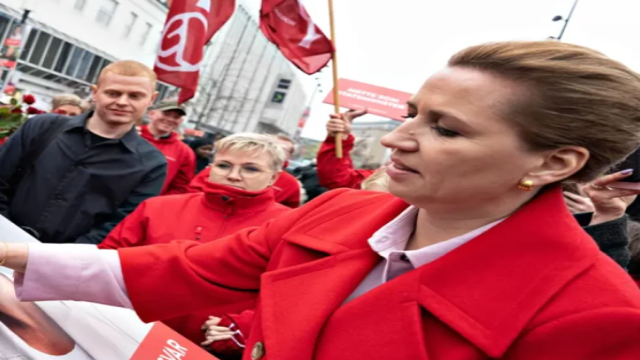
Copenhagen, March 25 (V7N)– In Denmark's general election on Tuesday, the Social Democrats, led by Prime Minister Mette Frederiksen, emerged as the largest party, but posted their weakest result in over 120 years. Despite finishing first, the left-wing bloc failed to secure a majority in the 179-seat parliament.
With all votes counted in metropolitan Denmark, the left bloc won 84 seats, while the right bloc secured 77, falling short of the 90 needed for a majority. The centrist Moderate party, led by Foreign Minister Lars Lokke Rasmussen, became the key player in forming a new government with 14 seats, setting the stage for potentially prolonged coalition negotiations.
Frederiksen, who has led Denmark since 2019, told her supporters she was ready to continue as Prime Minister, though she acknowledged that forming a government would not be easy. "There is little to suggest that forming a government will be easy," she stated, underlining the challenges ahead.
Lars Lokke Rasmussen emphasized the need for cross-bloc cooperation, despite the losses experienced by all parties in the left-right coalition government. "We must not be divided. We must not be red (left-wing). We must not be blue (right-wing). We have to work together," he said.
However, the coalition partner Troels Lund Poulsen of the Liberal Party ruled out forming a new government with the Social Democrats. "Either we have a centre-right government, or we go into opposition," he stated.
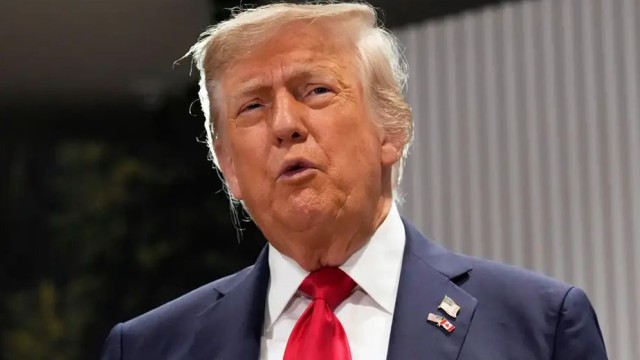
Frederiksen’s leadership has been widely praised for standing firm against US President Donald Trump's demands for Greenland's annexation, which is part of Denmark's territory. Despite the Social Democrats’ historical significance, the party's support dipped to just 21.8%, their lowest since 1903, down from 27.5% in the previous 2022 election.
Meanwhile, the Green Left Party recorded a strong performance, making it the second-largest party on the left. Leader Pia Olsen Dyhr emphasized that her party would prioritize welfare and green transition policies, and warned they would not join any government unless these priorities were met.
The far-right Danish People's Party saw a remarkable rise, more than tripling its vote share to 9.1%. Party leader Morten Messerschmidt expressed confidence, saying, "A tripling of votes is a remarkable expression of the Danish people in support of my party."
In Greenland, election interest surged as two seats are allocated to the island, with candidates vying for representation in Denmark's parliament. Greenlandic Prime Minister Jens-Frederik Nielsen emphasized the importance of unity in the territory amidst growing geopolitical tensions, notably with the United States.
Denmark's election also reflected growing concerns over immigration, with Frederiksen signaling support for further tightening migration policies. "The election has shown that there remains a broad majority in favour of a strict immigration policy in Denmark," she stated, reiterating the need to control the number of migrants entering the country.
With a highly fragmented result, Denmark now faces uncertain political negotiations as parties seek to form a stable government in a climate of domestic and international challenges.
END/WD/RH/








Comment: