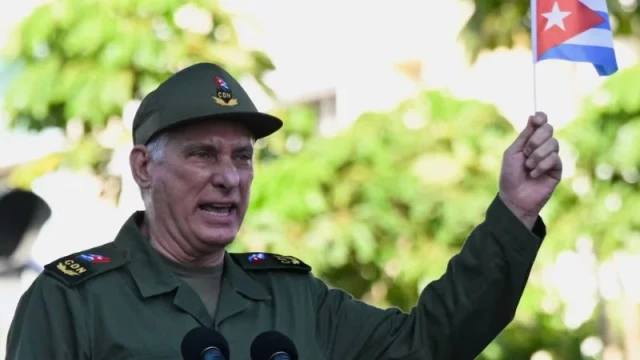
Washington, Jun 05 (V7N)- The United States has imposed fresh sanctions on Cuban President Miguel Díaz-Canel and several individuals and entities linked to Cuba's leadership, according to an announcement published by the U.S. Treasury Department on Thursday.
The sanctions target President Díaz-Canel, four other individuals, and five entities. Those included on the list are First Lady Lis Cuesta Peraza, two members of the Castro family, and Cuba's Ministry of the Revolutionary Armed Forces.
The Cuban government did not immediately comment on the sanctions.
Díaz-Canel, 66, became president of Cuba in 2018, succeeding former leader Raúl Castro. Since taking office, he has overseen the country during a period of economic challenges and strained relations with Washington.
Analysts view the latest measures as part of a broader U.S. strategy to increase pressure on Cuba's communist leadership. Speaking to reporters on the day the sanctions were announced, U.S. President Donald Trump said Washington wants Cuba to become a “well-governed country.”
Cuba strongly criticized the move. Foreign Minister Bruno Rodríguez Parrilla described the sanctions as “reprehensible” in a social media post, arguing that U.S. efforts to create tension between the two countries would ultimately fail.
The latest sanctions follow similar measures announced last month, when Washington imposed restrictions on 11 Cuban officials, including the country's Minister of Information and Communications, several military officers, and Cuba's principal intelligence agency.
The United States has also continued to pursue legal and diplomatic actions related to the 1996 downing of aircraft operated by a group opposed to the Cuban government. Washington has long alleged that Cuban military aircraft were responsible for shooting down the planes, an accusation that remains a point of contention between the two countries.
The new sanctions are expected to further strain already fragile relations between Washington and Havana, which have experienced periodic tensions over issues including human rights, political freedoms, and economic policy.
END/SMA/AJ