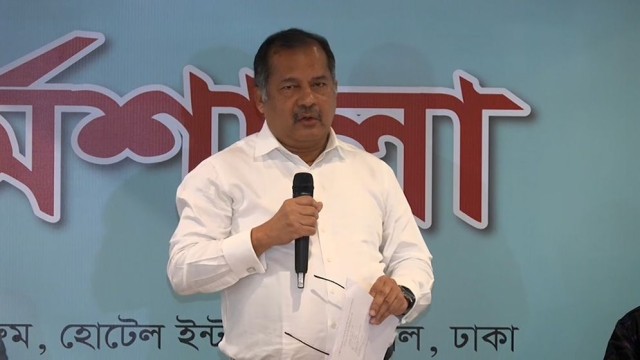
DHAKA, June 17 (V7N)— Environment, Forest and Climate Change Minister Abdul Awal Mintoo on Tuesday said land must be seen as the foundation of human existence, not just a means of production, stressing that “without healthy land, food security, biodiversity conservation, climate resilience and sustainable development cannot be achieved.”
Speaking as chief guest at a Department of Environment (DoE) workshop in Dhaka marking World Day to Combat Desertification and Drought 2026, the minister said the observance is a reminder of humanity’s responsibility to land, the environment, food security, livelihoods, and future generations.
This year’s theme, “Rangelands: Recognize, Respect, Restore,” underscores the need to conserve and restore grazing lands and natural grasslands globally. Mintoo noted that rangeland ecosystems make up nearly half the world’s land surface and are vital for billions of livelihoods, food systems, biodiversity, water regulation, and carbon storage.
While Bangladesh is not a desert country, it is vulnerable to desertification, land degradation, and drought, he said. Climate change, unplanned land use, falling soil fertility, rising salinity, river erosion, deforestation, and prolonged dry seasons are increasing degradation risks. Drought-prone areas in the northwest, saline-affected coastal lands, degraded hills, and fragile river basin ecosystems need special attention.
Citing research, the minister said moderate to very severe land degradation expanded from 10.70 million hectares in 2000 to 11.24 million hectares in 2020 — about 27,000 hectares lost annually over two decades. Drought-prone areas grew from 1.43 million hectares to 1.54 million hectares in the same period, covering nearly 10.4% of total land.
Irregular rainfall, long dry spells, excessive rain, flash floods, cyclones, and sea-level rise are putting multidimensional pressure on land and water, he said. In the Barindra region and other northwestern areas, drought is causing long-term harm to agriculture, water resources, and livelihoods.
Bangladesh signed and ratified the UN Convention to Combat Desertification in 1994 and has been implementing its commitments. Key government efforts include social forestry, coastal greenbelts, sustainable agriculture, integrated soil fertility management, organic fertilizer use, conservation agriculture, and climate-resilient crop varieties. The Barindra region has seen notable drought-management gains through water conservation, efficient irrigation, rainwater harvesting, and better groundwater management, Mintoo added.
He called for stronger global cooperation, urging more financial support, technology transfer, capacity-building, and knowledge-sharing. He also appealed to development partners, financial institutions, and UN agencies to boost investment in land restoration, drought mitigation, and nature-based solutions.
The government reaffirmed its commitment to achieve land degradation neutrality by restoring degraded forests, wetlands, char lands, and other ecosystems, strengthening drought early warning systems, and expanding IT use in science-based land management.
The workshop was chaired by DoE Director General Dr. Md. Lutfor Rahman and attended by Additional Secretary Dr. Fahmida Khanam, senior officials, development partners, UN representatives, researchers, academics, and environmentalists.
END/AJ/RH