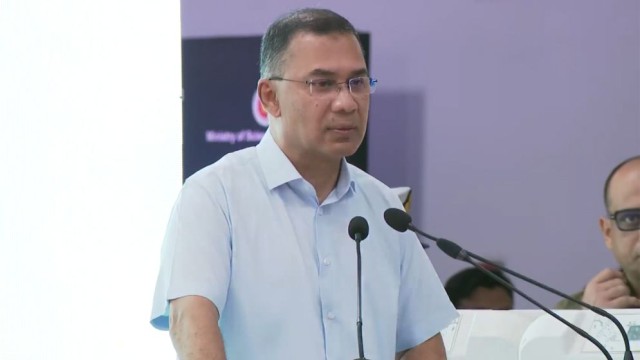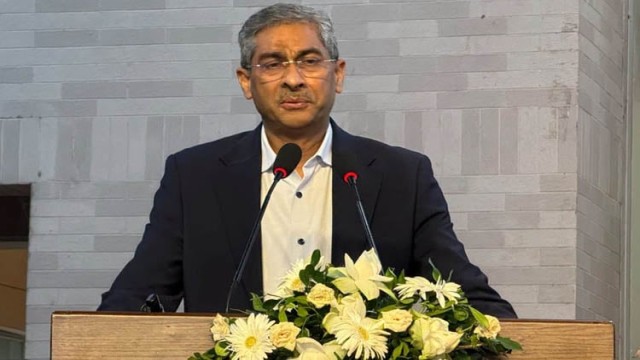
DHAKA, Sept 12, V7N - Water Resources Minister Md Shahid Uddin Chowdhury Anee today said the Padma Barrage and Teesta Master Plan are the major undertakings of the government that will contribute to building a new Bangladesh.
The minister made the remarks while addressing the ‘Fresher’s Orientation-26’ of North South University (NSU) at the main campus of the university as the chief guest.
Referring to the government’s plans, he said efforts are being made to implement the commitments outlined in the election manifesto despite the country’s difficult circumstances.
The government has undertaken a number of plans to rebuild the country in a new way, he said, adding that his ministry is advancing the canal excavation programme initiated by Shaheed President Ziaur Rahman.
“A programme to excavate 20,000 kilometres of canals across the country has been undertaken,” he said.
According to the minister, the objectives of the programme include supporting agricultural activities in rural areas, protecting the environment, promoting inland water transport and above all, preserving the ecosystem. “Retaining surface water is also one of our targets,” he said.
The Water Resources Minister urged the students to study environmental issues and water resources so that their knowledge could be put to practical use.
Addressing the newly admitted students, the minister recalled the contribution of Begum Khaleda Zia to the establishment of the first ever private university in 1993, saying that her role will always be remembered.
He also recalled the “unforgettable contribution” of NSU students to the July Mass Uprising in 2024.
“Education expands our thinking capability. But education without ethics is dangerous,” he said, referring to a remark made by a Nobel laureate.
He said acquiring education merely to obtain a job was not enough if that education could not subsequently be applied for the benefit of the society.
“Education has to be applied in society. We have to work for the people,” he said.
Recalling his own experience in prison, the minister said he was surprised to see that five trustees of North South University were detained behind bars for nearly five to six months.
“We may engage in politics in the streets and fields and that is why the fascist government sent us to jail. But even distinguished academics like them were not spared by Hasina,” he said.
The minister also stressed the importance of technological advancement, saying that artificial intelligence is helping the society to move forward.
“We have to increase our dependence on technology to meet the demand of the modern time,” he said adding that the country’s future could not be built solely on employment or bookish knowledge.
He also spoke about the role of social media, saying that while it had become an important platform for discussion, some of the content circulated through the medium was inappropriate.
The minister said the government wants to provide employment opportunities on the basis of merit. “We won’t consider any other criteria for employment,” he said.
NSU Vice-Chancellor Professor Dr. Abdul Hannan Chowdhury chaired the programme where members of the university’s Board of Trustees and former chairman M. A. Kashem, Benazir Ahmed and Professor Dipak Kumar Mitra spoke at the event.
Over 1000 newly admitted students of the Fall semester attended the programme.
END/AJ/RH