
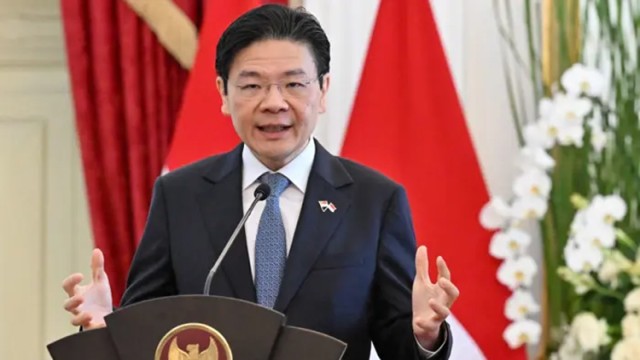
Singapore, May 1 (V7N) — Prime Minister Lawrence Wong warned Friday that Singapore’s economic growth will slow this year and some countries may slip into recession as the Middle East crisis continues to keep the Strait of Hormuz closed. Delivering his May Day speech, Wong cautioned that the war was not expected “to be over anytime soon” and that supply disruptions may worsen in the months ahead.
The Strait of Hormuz, a narrow waterway that handles nearly one-fifth of global oil and gas shipments, has been effectively shut since February 28, when the United States and Israel began bombing Iran. The closure has disrupted global energy flows, driving up prices and creating shortages across Asia and beyond.
“Here in Asia, we are especially affected because of our high dependence on energy and other critical supplies from the Gulf,” Wong said. He noted that some regional countries are already facing fuel shortages, airlines have cut flights, and factories are reporting delays.
Wong warned that the crisis is likely to trigger a wave of inflation worldwide. “Globally, inflation will rise, spreading from energy to food and then other essentials. Some economies may well slip into recession, and Singapore will feel the impact directly,” he said.
He explained that higher energy costs will ripple through supply chains, raising the price of food, manufactured goods, and services. For Singapore, a trade-dependent economy, the impact will be felt across businesses, workers, and households.
Although Wong did not provide specific figures, Singapore’s trade ministry in February had projected the economy to expand between 2.0 and 4.0 percent this year, an upward revision from its earlier forecast of 1.0 to 3.0 percent. The prime minister’s warning suggests that growth may now fall toward the lower end of that range.
“Our growth this year will slow, and inflation will be higher, and all this will put real pressure on businesses, workers and households,” Wong said. He urged Singaporeans to brace themselves for a more difficult period ahead: “I want to be upfront with all of you so that we are mentally prepared.”
Despite the challenges, Wong emphasized that Singapore is dealing with the crisis from a position of strength. Over the years, the city-state has invested heavily in energy resilience, becoming a major oil refining hub and energy trading center. These policies, he said, provide a buffer against external shocks.
Even so, Wong cautioned that reopening the Strait of Hormuz will not immediately restore normalcy. “Ports and energy infrastructure have been damaged. Shipping lanes will need to be cleared of mines. Confidence must be restored that it is safe for ships to sail through, that insurance can be obtained, and people are prepared to take risks to go through the Strait,” he explained.
The closure of the Strait has already had visible effects across Asia. Airlines have reduced flights due to fuel shortages, while factories report delays in receiving raw materials. Countries heavily reliant on Gulf energy supplies are struggling to maintain stability.
For Singapore, which imports nearly all of its energy, the crisis underscores the vulnerability of small, open economies to global disruptions. Wong’s remarks reflect growing concern that prolonged instability in the Middle East could derail recovery efforts across Asia.
The Strait of Hormuz has long been considered one of the world’s most strategic chokepoints. Any disruption in its operations has immediate consequences for global energy markets. The current closure, now in its third month, is among the most severe in decades.
Analysts warn that prolonged disruption could push oil prices to record highs, intensify inflation, and trigger recessions in vulnerable economies. The International Monetary Fund has already cautioned that global growth could slow significantly if the crisis persists.
Wong’s speech also served as a call for resilience at home. He urged businesses to adapt to higher costs, workers to prepare for potential job pressures, and households to manage rising expenses. The government, he said, will continue to support vulnerable groups and invest in long-term resilience.
Singapore’s past policies, including diversification of energy sources and building strategic reserves, provide some cushion. However, Wong acknowledged that no country can fully insulate itself from global shocks: “Today, no nation can safeguard its own peace and security by itself alone.”
Singapore’s May Day message reflects the gravity of the global energy crisis triggered by the closure of the Strait of Hormuz. With shipping halted, energy supplies disrupted, and inflation rising, economies across Asia face mounting challenges.
For Singapore, the outlook is sobering: slower growth, higher inflation, and pressure on businesses and households. Yet the government insists it is prepared, drawing on years of investment in energy resilience.
As Wong warned, even if the Strait reopens, recovery will be slow and uncertain. Mines must be cleared, infrastructure repaired, and confidence restored. Until then, Singapore and the world must brace for a prolonged period of economic turbulence.
END/WD/RH









Comment: