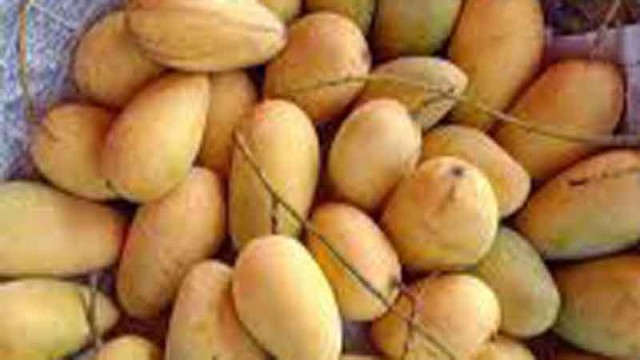
Rajshahi, Aug 24 (V7N) — While the traditional mango season in Bangladesh has come to an end according to the Bengali calendar, a different scene is unfolding in the Barind region of Rajshahi. Katimon mangoes are still hanging from trees across the area, creating what appears to be a fresh mango season after the traditional harvest period.
According to Mariam Ahmed, agriculture officer of Godagari Upazila, Katimon, also known as Sweet Katimon, is a variety originally introduced from Thailand. Unlike many traditional mango varieties, it can be cultivated throughout the year, giving it significant commercial potential. Demand remains strong even outside the conventional mango season, allowing farmers to obtain better prices. Farmers can harvest the variety twice a year, which has encouraged increasing numbers of growers to cultivate Katimon.
During a field visit on Friday, numerous Katimon orchards were found across the Barind tract of Godagari and along both sides of the road from Mundumala to Kalma in Tanore Upazila. Hundreds of orchards in Godagari and other parts of Rajshahi, as well as Chapainawabganj and Naogaon, are now producing clusters of Katimon mangoes.
Katimon mangoes were also seen in orchards along the Amnura–Nachole–Adda route in Chapainawabganj, the Porsha–Niamatpur road in Naogaon and near Lakshmipur intersection in Nachole. The small trees, laden with fresh mangoes, have become an attraction for people travelling through the region.
Mizanur Rahman, a farmer and owner of an orchard in the Bishwanathpur Bazar area of Godagari, said Katimon mangoes are highly sweet, have thin stones and are fibreless, making them popular among consumers.
“I have been cultivating Katimon, along with Gaurmati and Ilamati, in my 50-bigha mixed orchard for several years. Although the yield is comparatively low, I am very happy with the price I receive,” he said.
He added that people from various professions, including government officials, journalists, teachers, students, ministers, MPs, industrialists, businesspeople and farmers, have visited his orchard and praised its beauty.
According to Mizanur Rahman, Katimon mangoes are currently selling for Tk 200–300 per kilogram at the wholesale level. By harvesting the mangoes twice a year, he earns several lakh taka.
Tabarak Hossain, a farmer from Tanore, said he previously cultivated traditional varieties such as Gopalbhog, Langra and Khirsapat. However, as those varieties failed to generate sufficient returns compared with production costs, he removed the trees and planted around 2,500 Katimon trees on 25 bighas of land.
He expects a good yield from the orchard this year.
Suman Ali, a mango seller at Mahishalbari Bazar in Godagari Municipality, said traditional varieties such as Khirsapat, Gopalbhog and Langra had recently been selling for only Tk 25–50 per kilogram, leaving little or no profit for growers and traders.
“Thai Katimon mangoes are very sweet and delicious, fibreless and have a thin stone. Demand is very high, and they are selling for around Tk 250–330 per kilogram,” he said.
He said the Katimon season begins after the traditional mango season ends. Although the price is higher, consumers are keen to enjoy the mango because of its taste.
Sub-Assistant Agriculture Officer Atuno Sarker said Sweet Katimon is essentially a Thai variety of mango that can produce fruit throughout the year.
“The mangoes are exceptionally sweet and juicy, fibreless, and have very thin stones. The trees remain relatively small, making them suitable for rooftop gardens and even container cultivation,” he said.
He added that the fruit has a pleasant aroma and remains sweet even when unripe, without the sourness commonly found in green mangoes.
The growing popularity of Katimon mangoes is changing the traditional agricultural landscape of the Barind region. Anyone travelling along rural roads in the area can see orchards of different sizes filled with mangoes. Even after the conventional mango season has ended, the Katimon trees laden with fruit are giving the Barind region the appearance of a year-round mango festival.
END/MRA/SMA/