Dhaka, Oct 2 (V7N) – Fire Service and Civil Defence (FSCD) has taken initiatives to decentralise its manpower, rescue equipment and command structure so that rescue operations can continue even if any fire station or headquarters is damaged in a major earthquake, according to a BSS report.
Under the initiative, rescue equipment is being distributed among 41 points in and around Dhaka, a special rescue team is being stationed in Purbachal, separate rescue teams are being formed in divisional cities and 100 fire stations around Dhaka are being kept ready to provide emergency support to the capital.
Acting Officer of the Fire Service Media Cell Shahjahan Shikder told BSS that a major earthquake could require rescue operations to be conducted simultaneously in different areas. Considering this situation, he said, initiatives have been taken to decentralise manpower, rescue equipment and the command system of the Fire Service.
According to earthquake analysts, a major earthquake, often described as a mega-disaster, occurs roughly once in 100 years. As more than a century has passed since a major earthquake of such scale occurred in Bangladesh, there are concerns that a major earthquake could strike at any time. Unlike storms, which can sometimes be forecast two or three days in advance, no technology has yet been developed to predict earthquakes. Therefore, there is no alternative to preparedness and training.
The Fire Service officials said rescue and other emergency operations during earthquakes depend on the command structure. An initiative for decentralization has been undertaken to ensure the command system remains operational after any earthquake, even if the old FSCD headquarters building in Old Dhaka is damaged.
As part of the decentralisation initiative, arrangements have been made for two directors and other relevant command officials to work from Mirpur. The main part of the headquarters' media wing has also been shifted there. Meanwhile, activities of the training complex at Mirpur-10 have been relocated to the new Multipurpose Training Complex in Purbachal.
As safety concerns loom over the existing headquarters in Old Dhaka, an earthquake-resistant, multi-storey headquarters building is being constructed in Mirpur-10. With support from the Japan International Cooperation Agency (JICA), the building is being constructed using 'base isolation technology' for the first time in Bangladesh. The technology ensures that the building would not collapse even during a magnitude 8 earthquake. The project is scheduled to be completed by 2028 with the cooperation of the Public Works Department.
Equipment Distribution and Special Rescue Teams
Although individual Fire Service stations have manpower and equipment according to their requirements, most firefighting and rescue equipment had traditionally been kept at the headquarters. There is a risk that rescue operations could be hampered if the headquarters building collapses during an earthquake and the equipment becomes inaccessible. To address the risk, the equipment has been distributed across 41 points in and around Dhaka.
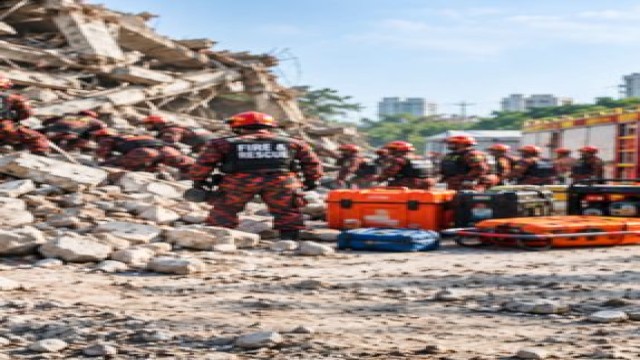
Manpower at individual fire stations may not be sufficient to deal with a major disaster such as an earthquake. Therefore, Special Rescue Teams (SRTs) have been formed. A special team comprising 50 to 60 members has been stationed in Purbachal. Similarly, teams have been formed at divisional headquarters, with each divisional headquarters having an SRT comprising 20 members. They have received specialised training to conduct collapsed-structure search and rescue operations during major disasters.
Dhaka, Chattogram and Sylhet are considered particularly vulnerable to major damage from an earthquake. Against this backdrop, 100 fire stations outside the divisional cities have been earmarked to provide support to Dhaka.
Communication and Coordination
Discussions have also been held with the Bangladesh Air Force on transporting rescue equipment and teams by helicopter if roads become inaccessible. An initiative is underway to sign a memorandum of understanding (MoU) in this regard.
A major fire or mega-earthquake could damage wireless coverage and mobile phone towers, disrupting communication among Fire Service units. Considering this risk, a nationwide communication exercise was conducted in August with the assistance of the Amateur Radio Association of Bangladesh (ARAB) .
Expert Perspective
Emphasising the need for integrated earthquake preparedness, Prof Dr Md Zillur Rahman of the Department of Disaster Science and Climate Resilience at Dhaka University told BSS that Bangladesh faces earthquake risks, particularly in the northeastern region, including Dhaka, Sylhet, Chattogram, Rangpur and Mymensingh. "Thus, integrated preparedness is necessary. Alongside increasing the number of trained Fire Service personnel, necessary small and large equipment should be procured, while regular drills, monitoring and maintenance should also be ensured," he said.
Director (Operations and Maintenance) of the Fire Service and Civil Defence Department Lieutenant Colonel Md Mahmudul Hasan told BSS that the biggest challenge for the FSCD after a major earthquake would be dealing with multiple disasters occurring simultaneously at different locations. "Particularly, building collapses, people becoming trapped, fires caused by gas-line ruptures and electrical accidents could make the situation more complex," he said. He noted that rescue vehicles could face difficulties reaching affected sites in densely populated cities like Dhaka due to narrow roads, traffic congestion, illegal parking and debris. "In such situations, our priorities will be rapidly assessing the situation, identifying trapped people, carrying out rescue operations on a priority basis and working in coordination with all relevant agencies. Simultaneously, ensuring the safety of rescuers will be extremely important," he added.
end/aj/rh/