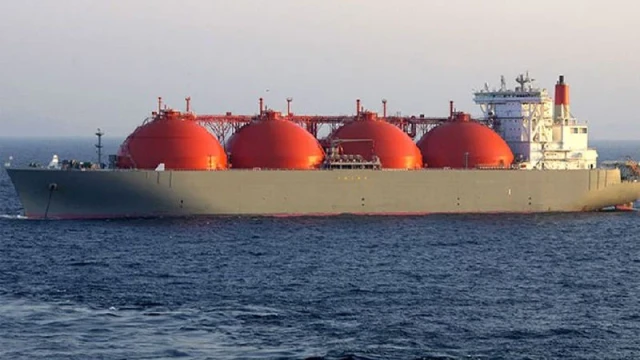
Dhaka, Aug 23 (V7N)- After remaining shut for three days, Accelerate Energy's LNG terminal in Maheshkhali has resumed gas supply through the national pipeline. Supply restarted on Saturday afternoon after a new LNG cargo was connected to the terminal.
Although gas availability in the national grid has increased slightly, the overall crisis has not yet eased. At the same time, reduced generation at several coal-fired power plants has increased load shedding in different parts of the country, leaving consumers without significant relief.
According to Petrobangla, at around 6 pm on Saturday, the country received a total of 2.311 billion cubic feet of gas. Of this, 1.624 billion cubic feet came from domestic gas fields, while 687 million cubic feet came from LNG after regasification.
The country's daily gas demand is around 4 billion cubic feet, leaving a deficit of approximately 1.69 billion cubic feet compared with demand.
Officials said Accelerate began supplying around 100 million cubic feet of gas per day from about 2 pm Saturday, with supply increasing later in the evening. There are plans to increase supply further, although full-capacity operation will depend on the terminal's technical condition and available LNG stock.
LNG terminal shutdown worsened crisis
Gas supply from Accelerate's floating LNG terminal in Maheshkhali, Cox's Bazar, was suspended on July 21 following a fire and technical damage. The shutdown reduced gas supply to the national grid by around 550–600 million cubic feet per day.
The prolonged disruption intensified the gas shortage in the power and industrial sectors.
After repairs to the damaged boiler, the terminal had been supplying a limited amount of gas from its existing LNG stock. However, with no new cargo arriving, the stock gradually declined. Supply eventually stopped completely around 3 pm on Wednesday.
Following the arrival of a new cargo, supply resumed on Saturday. In the meantime, gas was being supplied mainly through the Summit LNG terminal on a limited basis.
On Saturday, around 950 million cubic feet of gas was supplied to the power sector, while fertilizer plants received around 210 million cubic feet. As a result, shortages continued in industries and other sectors.
Load shedding increases
Meanwhile, reduced production from several coal-fired power plants caused load shedding in different areas, including Dhaka, despite Saturday being a holiday.
According to the Power Grid Company of Bangladesh (PGCB), electricity demand at 5 pm was 16,157 MW, against a supply of 14,273 MW.
Power Development Board Chairman Engineer Rezaul Karim said electricity generation remained low because of reduced coal-based production. Supply from the Adani power plant also declined.
Production at the Payra, Noringco and Matarbari power plants also fell during the day, although generation from some plants increased slightly in the evening.
Sources said Adani's generation dropped to around 955 MW at 1 am on Friday, compared with 1,304 MW at midnight. For most of Saturday, its supply remained between 800 and 900 MW.
Generation from Payra was around 300 MW lower, while combined output from Noringco and Matarbari was around 600 MW lower.
Dhaka Power Distribution Company (DPDC) sources said the maximum demand in their service area was around 2,333 MW, leaving a deficit of approximately 250 MW. As a result, several rounds of load shedding were reported in different areas.
In the DESCO area, demand stood at around 1,500 MW, with a deficit of approximately 400 MW.
Thus, although LNG supply has resumed, the country's energy crisis remains unresolved, with shortages in both gas and electricity continuing to affect consumers and industries.
END/SMA/AJ